

Publications
Bold names denote group members at the point of publication.
2026
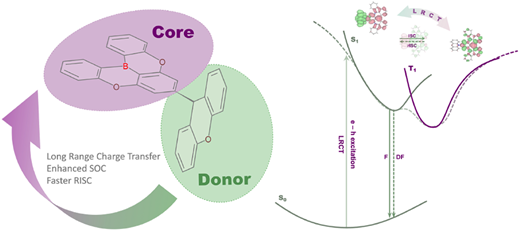
129. Long-Range Charge Transfer (LRCT)-Driven Enhancement of SOC and rISC in Donor-Modified MR-TADF Emitters
Abstract
Multi-Resonance Thermally Activated Delayed Fluorescence (MR-TADF) materials are leading candidates for high-efficiency narrowband Organic Light-Emitting Diodes (OLEDs), yet the electronic factors governing their reverse Intersystem Crossing (rISC) rates remain a subject of debate. In this work, we established a computational framework to investigate the factors governing the S1–T1 crossing in donor-modified MR-TADF emitters. By employing Orbital-Optimized DFT (OO-DFT), we achieved accurate predictions of the singlet–triplet gap (ΔEST) in close agreement with experimental data (RMSE = 0.079 eV). Using a specialized Charge Transfer descriptor CTS1T1, we screened 8 candidates exhibiting Long-Range Charge Transfer (LRCT) character during the S1–T1 transition out of a 20-molecule database. All selected candidates show enhanced SOC upon donor modification, with Spin–Orbit Coupling Matrix Element (SOCME) values of up to 1.1 cm-1. Marcus theory was applied to estimate qualitative spin-conversion trends and identify candidates with favorable crossing regimes. MECP analysis of the selected candidates shows how reorganization energy, seam accessibility, and energy-gap matching affect the S1–T1 crossing. ORCA ESD calculations of the elementary radiative rate kr, ISC rate kISC, and Franck–Condon contribution kISCFC were used to assess vibronic participation in the S1–T1 spin-flip process. These findings provide a theoretical perspective on the S1–T1 spin-flip mechanism and offer practical design insights for developing high-efficiency MR-TADF materials with intrinsically fast spin conversion.
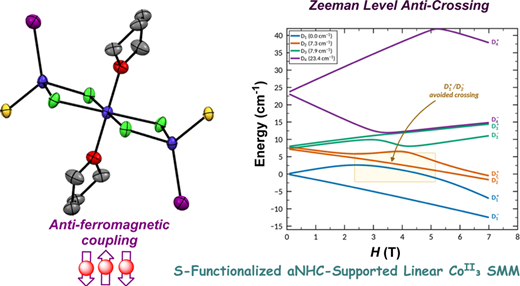
128. Zeeman Level Anti-Crossing and Slow Magnetic Relaxation in an S-Functionalized Abnormal NHC-Supported Linear CoII3 Single-Molecule Magnet
Abstract
A novel trinuclear cobalt(II) complex, [(S-MIC)2CoII3I2(μ2-Cl)4(THF)2]·4THF (1), supported by a zwitterionic ylide-type sulfur-functionalized abnormal N-heterocyclic carbene (S-MIC) ligand, has been synthesized and characterized as the first S-functionalized aNHC-supported cobalt(II) single-molecule magnet (SMM). X-ray diffraction reveals a linear trinuclear CoII3 core in which the central Co(II) adopts a distorted octahedral geometry, while each terminal Co(II) is distorted tetrahedral, coordinated by two μ2-chlorides, one terminal iodide, and one sulfur donor from S-MIC. The χT value of 10.3 cm3 K mol-1 at 300 K indicates significant orbital angular momentum contributions. Ab initio SA-CASSCF/NEVPT2 calculations with POLY_ANISO analysis reveal weak antiferromagnetic coupling (J = -3.39 cm-1; J' = -1.15 cm-1) and axial anisotropy (D values of -66.81 cm-1 for the central and -20.46 cm-1 for the terminal Co(II)). This weak coupling causes level anti-crossing of low-lying Zeeman levels, yielding open hysteresis and a marked magnetization-slope change near 35 kOe. Isothermal DC magnetization at 35 kOe confirms slow relaxation, with a τ of 451(3) s at 1.8 K. AC susceptibility measurements at 20 DC fields yield an effective barrier (Ueff = 25(20) K) under a QTM+Orbach model, discussed alongside ab initio calculations, underscoring the potential of S-functionalized carbene ligands for tuning coordination geometries and constructing multinuclear Co-based SMMs.
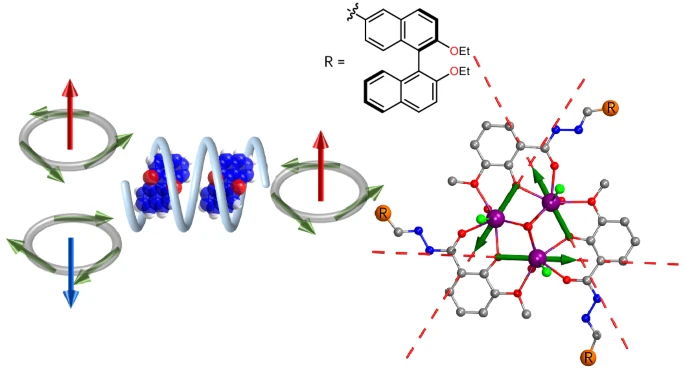
127. Homochiral toroidal spin state in Dy(III)-based single-molecule toroics
Abstract
Single-molecule toroics, materials that combine spin and chirality at the molecular level, are promising candidates for applications in data storage, chiral spintronics and magnetoelectric devices. Over the past two decades, substantial progress has been made in the design of toroidal spin states via ligand design and coordination chemistry strategies. However, achieving homochiral magnetic vortex configurations across both molecular and unit-cell scales—a key prerequisite to induce the toroidal polarization using a homogeneous magnetic field—remains challenging. Here we report enantiopure chiral dysprosium triangles in which introduction of structural chirality induces spin homochirality. μ-SQUID magnetometry and ab initio calculations evidence a non-coplanar spin texture that exhibits a toroidal ground state at low temperature. Furthermore, magneto-chiral dichroism spectroscopy, a technique sensitive to both chirality and magnetization, reveals unusual behaviours below 4.5 K, the temperature at which the coupling between Dy(III) ions favours the generation of a toroidal spin state.
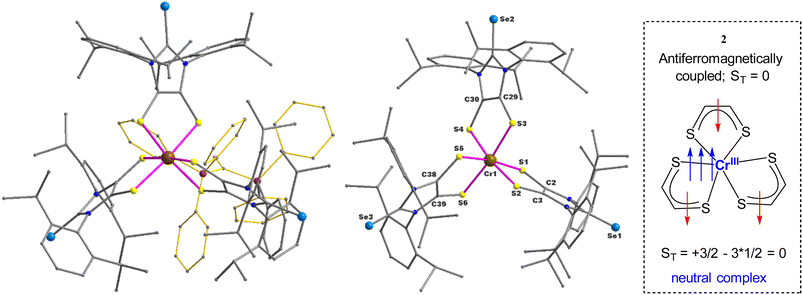
126. Air stable photo-redox active elusive Cr(iii)-tri-dithiolene-radical complexes as a new class of pseudo-supercapacitors with high capacitance: enhancement of energy storage with heavier chalcogenide
Abstract
Chromium, an earth-abundant metal with an accessible redox potential of −0.74 V vs. RHE, emerges as a promising element for the design of high-energy-density supercapacitors. Beyond their intriguing chemistry, energy storage devices employing stable redox-active radicals of main-group elements gain increasing attention for sustainable applications. Herein, the pseudo-supercapacitive properties of two unprecedented, photo-redox active, air-stable Cr(III)-triradical complexes with the general formula [Cr(III)(SS-NHC = E•−)3] (1, E = S; 2, E = Se; (SS-NHC = E) : S2-donor dithiolene ligand) are reported. Electrochemical anodes fabricated by coating these complexes onto stainless-steel substrates exhibited excellent supercapacitance performance. Complex 1 delivered a specific capacitance of 145.2 F g−1, while complex 2 showed a markedly higher value of 340.9 F g−1 at 5 mV s−1, centred at E1/2 = −0.72 V. Cycling stability reached 81.2% for complex 1 and 87.3% for complex 2 after 3000 cycles. The superior activity of complex 2 arises from the substitution of sulfur with selenium in the SS-NHC = E•− ligand, which enhances redox activity, conductivity, and ion transport. Ragone plot analysis confirmed a higher energy density (14.63 Wh kg−1 at 252 W kg−1) for complex 2 compared to complex 1 (8.76 Wh kg−1 at 211 W kg−1). Mechanistic studies revealed that complex 1 operated via mixed surface- and diffusion-controlled processes, whereas complex 2 predominantly followed diffusion control, enabling efficient charge transport and improved pseudocapacitive behaviour.
2025
125. Silaiminyl-Silylene-Derived Unsymmetrical Diradicaloid Silacycles Isolated in Three Different Charge and Spin States
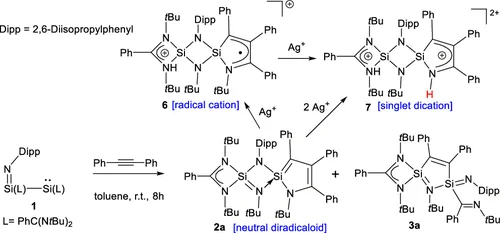
Abstract
Organosilicon diradicals with singlet or triplet spin states of the two unpaired electrons are one of the foci in main group chemistry. However, to date, the reported isolable ones are still scarce owing to their high reactivity and lack of suitable synthetic methods. In this article, a series of diradical silacycles and their corresponding isomers 1,3-disila-pyrroles were facilely obtained via the reactions of a silaiminyl-silylene (1) serving as a precursor of “masked” bis-silylene, with various diarylacetylenes. The computed reaction mechanisms indicated a concomitant and energetically favored formation of both isomers through distinct paths. Theoretical studies demonstrated that the singlet diradicaloid silacycles (2) bear two unpaired electrons asymmetrically distributed in the molecular backbone and have a remarkably small singlet-triplet energy gap that results in the observable NMR and electron paramagnetic resonance signals. Moreover, the reactivity studies of the diradical silacycle were also conducted, giving rise to multiple hydrochlorinated products under the treatment of HCl and a monoradical cation (6) and a dication (7) via stepwise oxidation of AgOTf. Compounds 6 and 7 were isolated, characterized, and studied by density functional theory calculations. Interestingly, the heterocyclic compound 4 containing a CNPSi2 ring isolated from the reaction of 1 and Ad-C≡P showed Möbius-type aromaticity with the NICS(0) value of -6.8.
124. Efficient modeling of dynamic properties in K3C60 using machine learning force fields
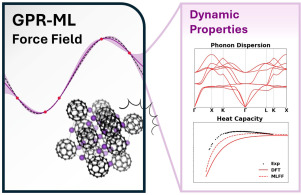
Abstract
Dynamic properties of the alkali-doped molecular crystal K3C60 are investigated using machine learning force field (MLFF). Our trained force fields successfully reproduce phonons comparable to those from density functional theory 10-times faster in computational efficiency. Specific heat with MLFF also show good agreement with experimental data, demonstrating its reliability for thermodynamic analysis. Two descriptor schemes, Smooth Overlap of Atomic Positions and Atomic Cluster Expansion, are employed and systematically compared. This study represents the first detailed exploration of dynamic properties in molecular crystals using MLFF, highlighting MLFF's potential in more complex molecular crystals, such as C60 disorder in fullerides, molecular melting.
123. Isolation and characterization of carbene-supported air stable Co(II)-radical complexes with bileptic redox non-innocent ligands: stability, bonding, ring-opening copolymerization studies and photo-catalytic ring cyclization activity
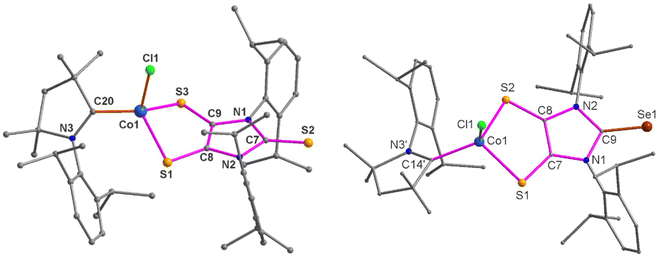
Abstract
Two redox-active Co(II)-radical complexes (3a and 3b), featuring a high-spin tetrahedral Co(II) ion, have been isolated as dark blue needles and remain stable in air for over a week. These complexes contain two redox non-innocent ligands (a carbene and a dithiolene), each with different coordinating atoms (two sulfur atoms and one carbon atom). Cyclic voltammetry (CV) reveals that complex 3a and 3b can form their corresponding mono-cation at potentials above −0.61 V. The structure of the complexes has been determined by single-crystal X-ray diffraction, and it has been further characterized by UV-vis, IR, Raman, EPR, and spectroscopy. DC/AC magnetometry measurements of complex 3a show antiferromagnetic coupling between the high-spin tetrahedral Co(II) ion and the dithiolene-centered radical electron, as concluded from DFT calculations, with support from EPR measurements. Quantum mechanical magnetic model fitting to the experimental data sets suggested that complex 3a exists in equilibrium between S = 1 and S = 2 states, depending on temperature, as reflected in the M vs. H plots. The stability, bonding, and electron density distribution of this air-stable complex 3a have also been studied using various quantum chemical calculations. This dark-colored, photo-redox active complex (3a) was found to catalyse the synthesis of the well-known alkaloid natural product, N-isopentylcrinasiadine (5b), under photocatalytic conditions using a 427 nm Kessil light source. Additionally, complex 3a also catalyses a copolymerization reaction in the presence of a chloride ion.
122. Enhanced Easy Axis Magnetic Anisotropy in a Siloxane-Bridged Linear CoII3 Single-Molecule Magnet
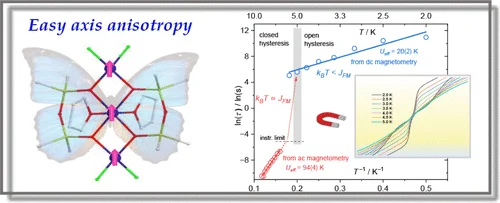
Abstract
A novel ferromagnetically coupled dianionic linear CoII3 complex has been synthesized and characterized as a potential single-molecule magnet (SMM) with enhanced axial magnetic anisotropy. This complex features three CoII ions out of which one CoII ion adopts an octahedral geometry and two other CoII ions adopt tetrahedral coordination geometries. The CoII ions are bridged by two siloxane dianions in a η2:η2:μ3 fashion leading to a butterfly-like molecular structure, which has been studied by magnetic susceptibility measurements. Computational analysis using OpenMOLCAS, CASSCF, and CASPT2 methods revealed ferromagnetic (FM) exchange coupling between the neighboring CoII ions of about +10.2 cm–1 and strong axial anisotropy parallel to the Co–Co axis for the ground exchange states. From ab initio POLY-ANISO analysis, a total magnetization blocking barrier of about 70 cm–1 (101 K) and strongly reduced probabilities for quantum tunneling due to FM coupling were predicted. Magnetic ac susceptibility measurements revealed slow magnetic relaxation via an Orbach relaxation process with Ueff = 94(4) K and τ0 = 4(2)×10–10 s (fitted from 8.5 to 6.25 K). Below 5 K, a pinched open hysteresis can be observed that opens more when approaching 2 K, indicating very slow magnetic relaxation in this temperature range in agreement with the predicted small quantum tunneling probabilities. These very slow magnetic relaxation times were further investigated by time-dependent dc magnetometry. Our study presents the first report on the influence of siloxane bridge binding on the SMM property of CoII nuclei by in-depth theoretical analysis and experimental susceptibility measurements, indicating the design of improved materials.
121. Isolation and oxygen activation of electron-rich CoII4O metallic clusters having a 3-fold symmetry
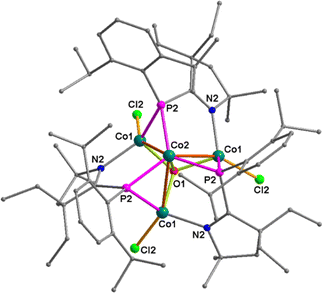
Abstract
Two novel atomically precise tetra-nuclear cobalt clusters (3a–3b) having a CoII4O core with 3-fold symmetry, and three short Co–Co distances of 2.7046(4) Å are isolated with three chelating NP-donor mono-anionic ligands. 3a–3b are shown to react with O2, producing dinuclear cobalt complexes (4a–4b), where the P-centres of the ligands are oxygenated. All complexes are structurally characterized by single-crystal X-ray diffraction, and further studied by UV-vis, IR spectroscopy, CV, magnetic susceptibility measurements, and DFT calculations.
120. Expanding the Molecular Switches Toolbox: Photoreloadable Dithienylethene Mechanophores
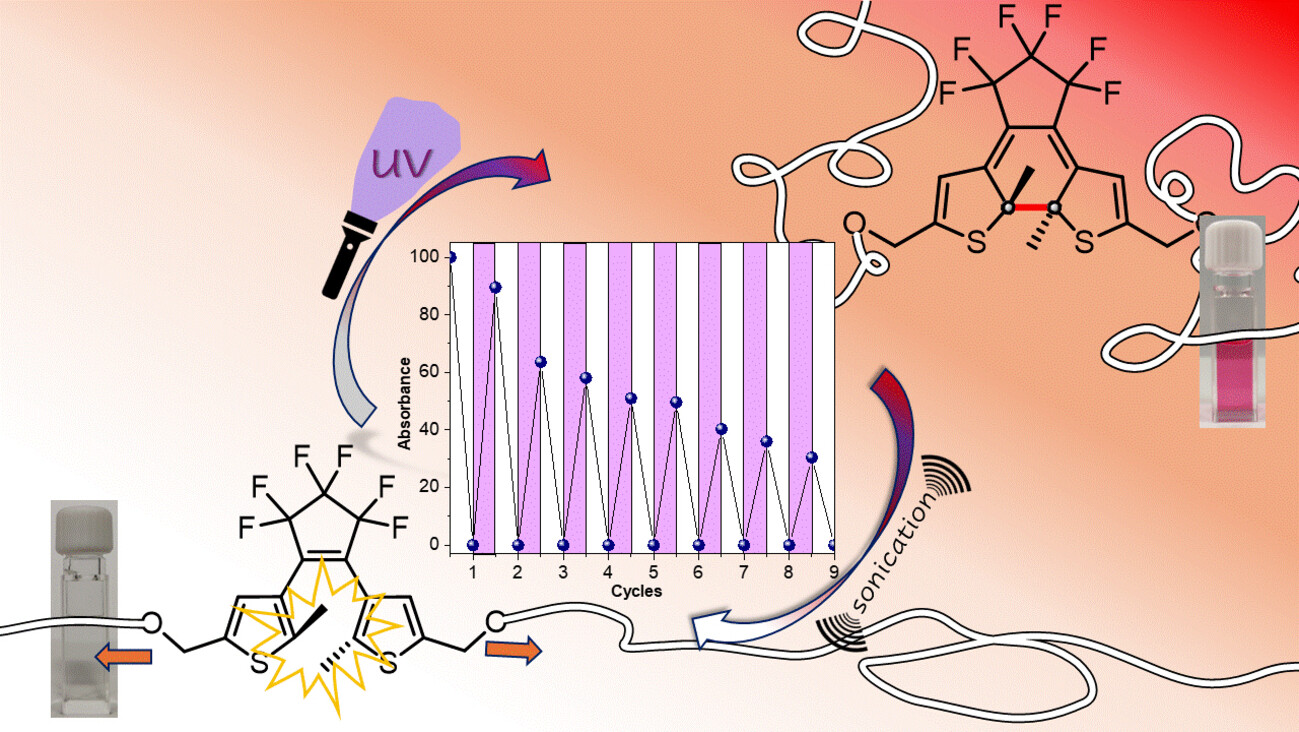
Abstract
Molecular switches are often thought of as nanoscopic equivalents to the electrical buttons and knobs ubiquitous in everyday life. However, mechanical force is rarely used to reversibly trigger rearrangements at the atomic scale, due to the difficulty in selectively breaking certain bonds, while keeping others intact. Here, we introduce two new mechanophores based on dithienylethene (DTE), which can be toggled between two states by ultraviolet light and sonication. Attaching various lengths of poly(ɛ-caprolactone) either to the 2,2' or the 5,5' positions of the DTE core allowed us to study the kinetics of its mechanochemical cycloreversion. We employed computational methods to understand the root causes of the observed mechano-regiochemical differences. Lastly, we show that our best performing DTE-polymer conjugate can undergo numerous switching cycles by the alternating action of electromagnetic radiation and mechanical force.
119. 187 Os nuclear resonance scattering to explore hyperfine interactions and lattice dynamics for biological applications
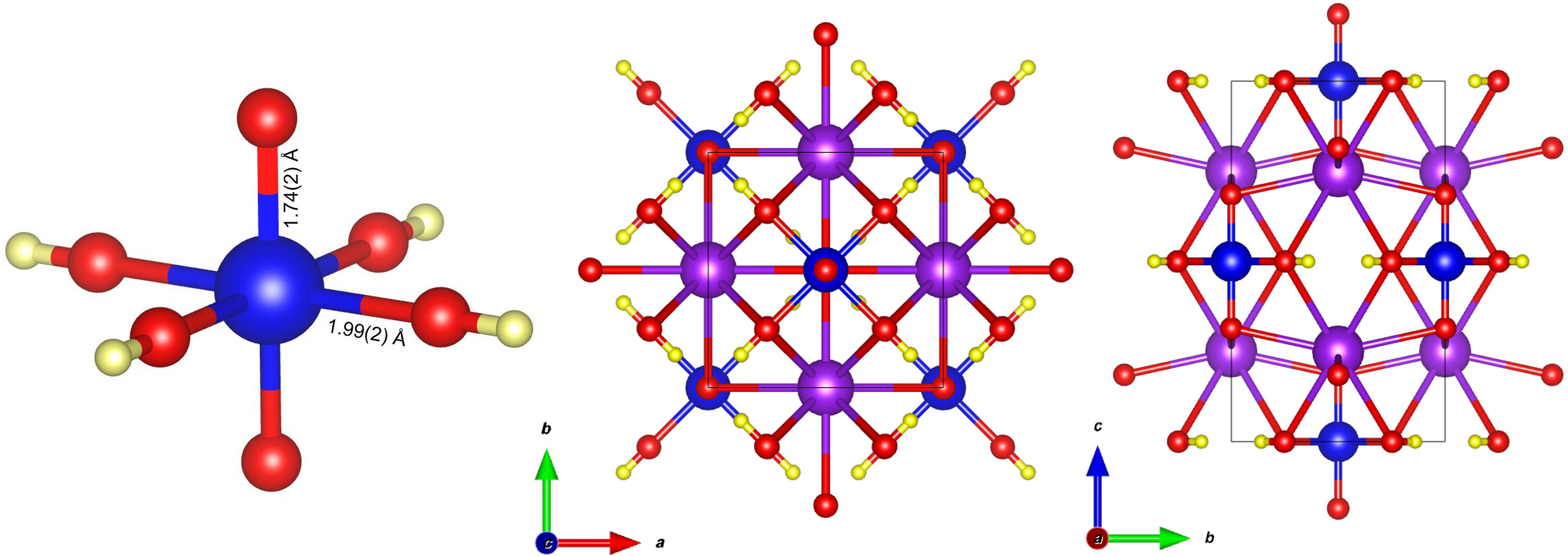
Abstract
Osmium complexes with osmium in different oxidation states (II, III, IV, and VI) have been reported to exhibit antiproliferative activity in cancer cell lines. Herein, we demonstrate unexplored opportunities offered by 187Os nuclear forward scattering (NFS) and nuclear inelastic scattering (NIS) of synchrotron radiation for characterization of hyperfine interactions and lattice dynamics in a benchmark Os(VI) complex, K2[OsO2(OH)4]. We determined the isomer shift [δ = 3.3(1) millimeters per second] relative to [OsIVCl6]2− and quadrupole splitting [ΔEQ = 12.0(2) millimeters per second] with NFS. We estimated the Lamb–Mössbauer factor [0.80(4)], extracted the density of phonon states, and carried out a thermodynamics characterization using the NIS data combined with first-principles calculations. Overall, we provide evidence that 187Os nuclear resonance scattering is a reliable technique for the investigation of hyperfine interactions and Os-specific vibrations in osmium(VI) species and is thus applicable for such measurements in osmium complexes of other oxidation states, including those with anticancer activity such as Os(III) and Os(IV).
118. Modulating Static and Dynamic Magnetizations of Ytterbium(III) Coordination Polymers by Light-Induced Radicals
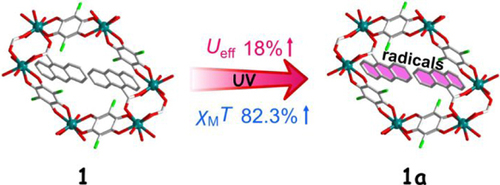
Abstract
Light-induced transformation from diamagnetic ligand to paramagnetic radical offers a unique approach to modulating the magnetization dynamics of magnetic compounds. In this study, we present a two-dimensional Yb(III) coordination polymer 1 and its Y(III)-diluted analog 1@Y, along with their light-induced radical forms, 1a and 1a@Y. Due to the presence of light-induced radicals, the magnetic susceptibility properties (χMT values) of 1a and 1a@Y featured remarkable 82.3% and 88.9% enhancements, respectively, at room temperature, compared with those of 1 and 1@Y, and were accompanied by an unexpected increase in the effective energy barrier for magnetization dynamics. The magnetization dynamics of 1 and 1a involved both Orbach and Raman processes, while 1@Y and 1a@Y exhibited two Raman processes, indicating that the Orbach process that occurred in 1 and 1a was mainly attributed to the magnetic coupling between Yb(III) ions. This work showcases the potential of light-induced radical transformation for tuning both the static and dynamic magnetic properties of lanthanide coordination polymers.
2024
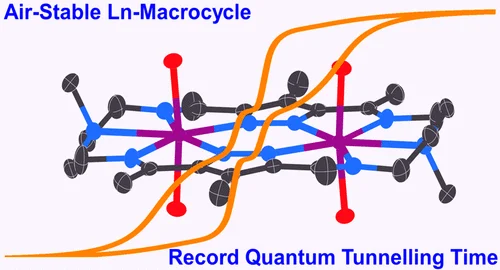
117. Record Quantum Tunneling Time in an Air-Stable Exchange-Bias Dysprosium Macrocycle
Abstract
In recent years, dysprosium macrocycle single-molecule magnets (SMMs) have received increasing attention due to their excellent air/thermal stability, strong magnetic anisotropy, and rigid molecular skeleton. However, they usually display fast zero-field quantum tunneling of the magnetization (QTM) rate, severely hindering their data storage applications. Herein, we report the design, synthesis, and characterization of an air-stable monodecker didysprosium macrocycle integrating strong single-ion anisotropy, near-perfect local crystal field (CF) symmetry, and efficient exchange bias. These indispensable features enable clear-cut elucidation of the crucial role of very weak antiferromagnetic coupling on magnetization dynamics, creating a prominent SMM with a large effective energy barrier (Ueff) of 670 cm-1, open hysteresis loops at zero field up to 14.9 K, and a record relaxation time of QTM (τQTM), 24281 s, for all known nonradical-bridged lanthanide SMMs.
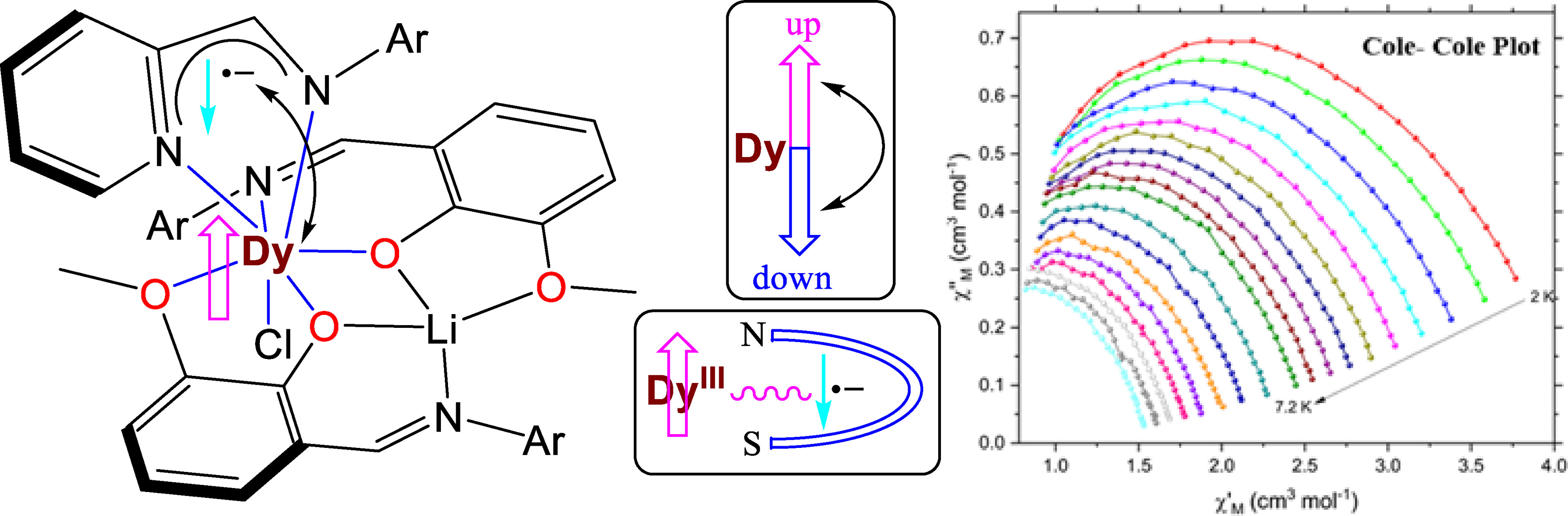
116. Dysprosium-Radical Based Single-Molecule Magnet Containing a Seven Coordinate Dy(III) Ion: A System for ab initio Study
Abstract
Single–ion magnets (SIMs) possessing a DyIII ion have recently attracted huge scientific attention. Herein, we report on a DyIII-radical single–molecule magnet containing a seven-coordinate DyIII ion with an O3N3Cl donor set. The frequency–dependent slow relaxation of magnetization has been observed below 8 K. DC magnetic studies have shown the presence of weak antiferromagnetic coupling between the Kramers ion (DyIII, J = 15/2) and the ligand-centered radical electron (S = 1/2) which was confirmed by multifunctional CASSCF calculations.
2023
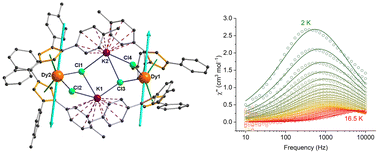
115. Dipotassiumtetrachloride-bridged dysprosium metallocenes: a single-molecule magnet
Abstract
The present work describes the dynamic magnetic properties of the complex [(CpAr3)4DyIII2Cl4K2]·3.5(C7H8) (1), synthesized by employing a tri-aryl-substituted cyclopentadienyl ligand (CpAr3), [4,4′-(4-phenylcyclopenta-1,3-diene-1,2-diyl)bis(methylbenzene) = CpAr3H]. Each DyIII-metallocene weakly couples via K2Cl4, displaying slow relaxation of magnetization below 14.5 K under zero applied dc field via KD3 energy levels with an energy barrier of 136.9/133.7 cm-1 on the Dy sites. The single-ion axial anisotropy energy barrier is reduced by geometrical distortion due to the coordination of two chloride ions at each Dy centre.
114. The OpenMolcas Web: A Community-Driven Approach to Advancing Computational Chemistry
Abstract
The developments of the open-source OpenMolcas chemistry software environment since spring 2020 are described, with a focus on novel functionalities accessible in the stable branch of the package or via interfaces with other packages. These developments span a wide range of topics in computational chemistry and are presented in thematic sections: electronic structure theory, electronic spectroscopy simulations, analytic gradients and molecular structure optimizations, ab initio molecular dynamics, and other new features. This report offers an overview of the chemical phenomena and processes OpenMolcas can address, while showing that OpenMolcas is an attractive platform for state-of-the-art atomistic computer simulations.
113. Calculations of Magnetic Exchange in Multinuclear Compounds
Abstract
The magnetic exchange interaction between metal centers in multinuclear compounds plays a defining role in their low-temperature magnetic behavior. Predicting magnetic exchange by computational methods is of high importance for the development of novel magnetic, spintronic materials, and devices that drives further the development of advanced computational methods. In this chapter, we give a brief overview of the origin of magnetic exchange and describe various microscopic theories accounting for it. Several computational approaches which allow the estimation of magnetic exchange in multinuclear compounds are reviewed. Computational challenges of the existing methods for accounting for the magnetic exchange will be discussed in detail in subsequent sections. The combination between accurate on-site eigenstates obtained in ab initio calculations (CASSCF + SOC + ANISO) and theoretical modeling of the magnetic dipole–dipole and exchange interactions within the Lines model, and the recently developed kinetic exchange model is described alongside several recent examples. The last section offers a review of several results obtained recently and gives our perspective on how to achieve an efficient interplay between strong magnetic exchange and a highly axial crystal field on metal sites for designing better exchange-coupled multinuclear single-molecule magnets.
2022
112. Carbonate-free CoAl layered double hydroxides supercapacitors: Controlled precipitation via acid mediated decomplexation
Abstract
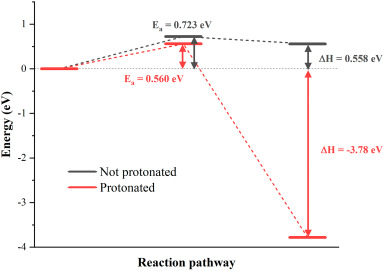
Layered double hydroxides (LDH) belong to a class of highly versatile compounds used in a myriad of applications such as energy storage, catalysis, heavy metal adsorption, etc. Given the high tunability of its structure, ranging from different metal cations to different types of intercalations, LDH can be readily customised to suit the intended applications. One of the inherent problem of LDH lies in their carbonate contamination. The presence of CO32- anions in the intercalation greatly affects the versatility and tunability of LDH. Carbonate intercalation also poses as an interfering species for reactions involving carbonate as intermediates or final products. Unfortunately, existing synthesis procedures of LDH produce either carbonates during the precipitating process or poorly crystallised LDH that absorbs atmospheric carbon dioxide to form carbonates during the drying process; either way results in carbonate contaminated LDH. In this work, we address the problem with the use of ethylenediamine (EDA) complexation followed by controlled decomplexation to prepare CoAl LDH (LDH-EDA). It is shown that the obtained LDH-EDA is carbonate-free and outperforms the CoAl LDH obtained using conventional urea method (LDH-Urea) in terms of crystallinity, surface area and pseudocapacitive properties. Through a detailed experimental and computational study of the preparation mechanism, we propose that ammonium nitrate acts as an acid that mediates the decomplexation of the cobalt (II) trisethylenediamine complex, freeing Co2+ ion in a control manner for the second precipitation process. The multistep process has allowed a controlled rate of formation of LDH, resulting in the highly crystalline LDH-EDA microstructures with pure nitrate intercalation and a flower-like morphology.
111. Mechanisms of Luminescence in Lanthanide Complexes: A Crucial Role of Metal–Ligand Covalency
Abstract
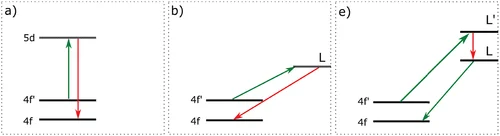
A current understanding of the luminescence of lanthanide complexes is based on the phenomenological Judd–Ofelt (JO) theory. However, the mechanisms of electric-dipole transitions lying at its basis were never subjected to a rigorous analysis. Here, we investigate the contributions to the electric-dipole transitions in the Er3+ 4S3/2 → 4I15/2 band of an erbium trensal complex using state-of-the-art ab initio calculations. We find that the conventional JO mechanism based on the electrostatic crystal field yields only a quarter of the integral intensity of this band. Accordingly, three quarters of it is contributed by covalent binding of erbium and ligand orbitals via three major mechanisms, the 4f ligand and ligand-ligand electric-dipole transitions and covalent enhancement of the hybridization of 4f and even empty orbitals of erbium. We expect that these findings will inspire the design of efficient rare-earth luminescent materials.
110. [AuI (CN)2 ]-Armed [FeIII2 FeII2 ] Square Complex Showing Unusual Spin-Crossover Behavior Due to a Symmetry-Breaking Phase Transition
![Graphical abstract for [Au<sup>I</sup> (CN)<sub>2</sub> ]-Armed [Fe<sup>III</sup><sub>2</sub> Fe<sup>II</sup><sub>2</sub> ] Square Complex Showing Unusual Spin-Crossover Behavior Due to a Symmetry-Breaking Phase Transition](assets/publications/2022/You_IC_2022.png)
Abstract
The incorporation of two different cyanide building blocks of [(TpR)FeIII(CN)3]- and [AuI(CN)2]- into one molecule afforded a novel hexanuclear [FeIII2FeII2AuI2] complex (1·2Et2O), in which the cyanide-bridged [FeIII2FeII2] square was further grafted by two [AuI(CN)2]- fragments as long arms in syn orientations. Complex 1·2Et2O undergoes a gradual spin crossover (SCO) from low-spin (LS) to high-spin (HS) state for the FeII centers upon desolvation. Remarkably, its desolvated phase (1) exhibits a reversible but atypical two-step (sharp-gradual) SCO behavior with considerable hysteresis (21 K). Variable-temperature single-crystal X-ray structural studies reveal that the hysteretic spin transition takes place synchronously with the concerted displacive motions of the molecules, representing another rare example including multistep and hysteretic spin transitions due to the synergetic SCO and structural phase transition.
109. Stable Triarylmethyl Radicals and Cobalt(II) Ions Based 1D/2D Coordination Polymers
Abstract
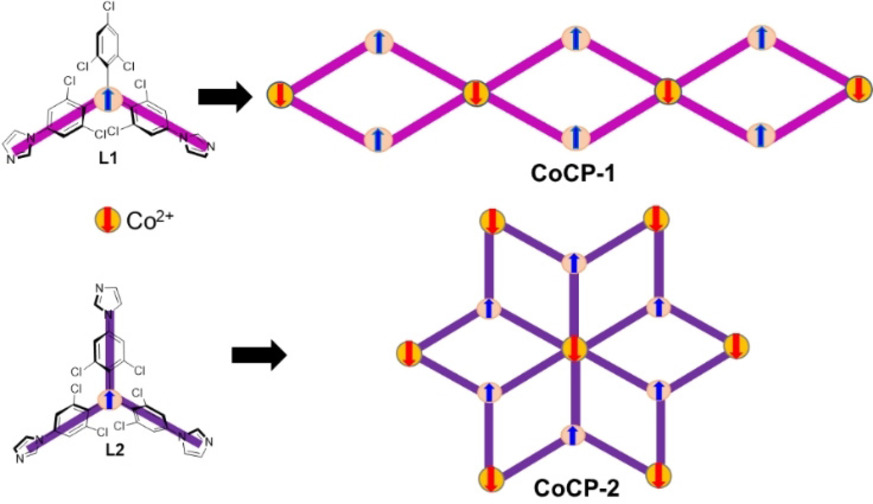
The incorporation of organic radicals into coordination polymers was considered as a promising strategy to promote metal-ligand exchange interactions, but there are only a very limited number of stable organic radical-based ligands that can serve well such a purpose. Herein, we report two new tris(2,4,6-trichlorophenyl)methyl (TTM) radical-based ligands L1 and L2 with two and three imidazole substituents, respectively. The imidazole unit serves as a coordination site and it can also stabilize the TTM radical by intramolecular donor–acceptor interaction. Coordination of L1 and L2 with cobalt(II) ions gave the corresponding one- (CoCP-1) and two-dimensional (CoCP-2) coordination polymers, the structures of which were confirmed by X-ray crystallographic analysis. Magnetic measurements and theoretical calculations suggest antiferromagnetic coupling between the paramagnetic cobalt(II) ions and the radical ligands. Our study provides a rational design for stable organic radical-based ligands and further demonstrated the feasibility of a metal–radical approach toward magnetic materials.
108. The Role of Radical Bridges in Polynuclear Single-Molecule Magnets
Abstract
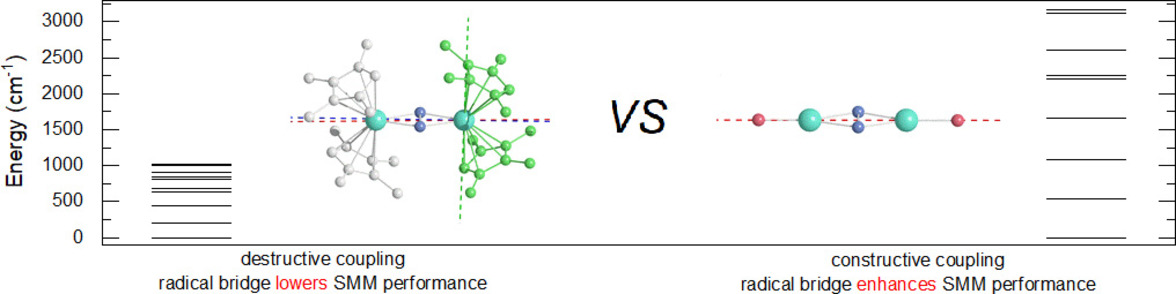
Employing radical bridges between anisotropic metal ions has been a viable route to achieve high-performance single-molecule magnets (SMMs). While the bridges have been mainly considered for their ability to promote exchange interactions, the crystal-field effect arising from them has not been taken into account explicitly. This lack of consideration may distort the understanding and limit the development of the entire family. To shed light on this aspect, herein we report a theoretical investigation of a series of N23--radical-bridged diterbium complexes. It is found that while promoting strong exchange coupling between the terbium ions, the N23--radical induces a crystal field that interferes destructively with that of the outer ligands, and thus reduces the overall SMM behavior. Based on the theoretical results, we conclude that the SMM behavior in this series could be further maximized if the crystal field of the outer ligands is designed to be collinear with that of the radical bridge. This conclusion can be generalized to all exchange-coupled SMMs.
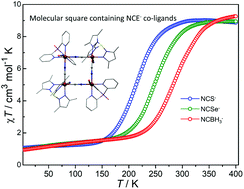
107. Manipulating the spin crossover behaviour in a series of cyanide-bridged {FeIII2FeII2} molecular squares through NCE- co-ligands
Abstract
Manipulating the transition temperature (T1/2) of spin-crossover (SCO) complexes capable of fulfilling practical criteria through different synthetic strategies is one of the main focuses in the field of molecular magnetism. The reaction of the tricyanometallate precursor [(Tp*)FeIII(CN)3]− and FeII salt with the “facially” tridentate ligand tris(2-pyridyl)phosphine oxide (TPPO) and NCE− anions afforded three isostructural {FeIII2FeII2} square complexes {[(Tp*)FeIII(CN)3]2[FeII(TPPO)]2[NCE]2}·Sol (E = S, Sol = 2CH3OH·6H2O, 1; E = Se, Sol = 2MeCN·2CH2Cl2·2H2O, 2; E = BH3, Sol = 4CH3OH·2MeCN, 3). Detailed structural analysis, variable-temperature IR analysis, magnetic susceptibility measurements and DFT calculations revealed that all compounds exhibit complete and one-step SCO behaviour between the {FeIII,LS2FeII,HS2} and {FeIII,LS2FeII,LS2} electronic states. As the ligand field increases from NCS− to NCSe− to NCBH3−, T1/2 shifts dramatically from 214 to 250 to 288 K for 1, 2 and 3, respectively, demonstrating another effective way to tune the SCO properties of the [FeIII–CN–FeII] systems through the introduction of NCE− co-ligands.
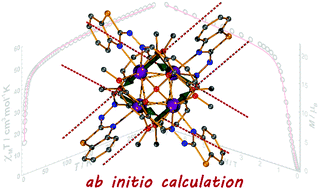
106. Toroidal versus centripetal arrangement of the magnetic moment in a Dy4 tetrahedron
Abstract
Magnetic investigation and ab initio calculations reveal toroidal arrangement of the magnetic moment rather than centripetal anisotropies in a tetrahedral Dy4 complex.
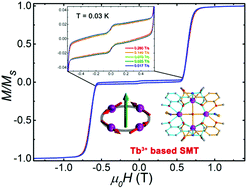
105. Toroidal magnetic moments in Tb4 squares
Abstract
Terbium-based complexes are passable in the study of single molecule toroics (SMTs). Herein, the syntheses and characterizations of a series of Tb4 SMTs isolated from reduced or dimerized Schiff base ligands are presented. These complexes share a similar μ4-O bridged Tb4 square core and show diamagnetic ground states. Micro-SQUID technique was carried out on a single-crystal sample and the results suggest that there is a toroidal arrangement of the magnetic moments. Ab initio calculations are performed on these complexes and confirm the mixed-moment SMT properties. This allowed us to access a new strategy for generating single molecule toroics in terbium-based molecules.
2021
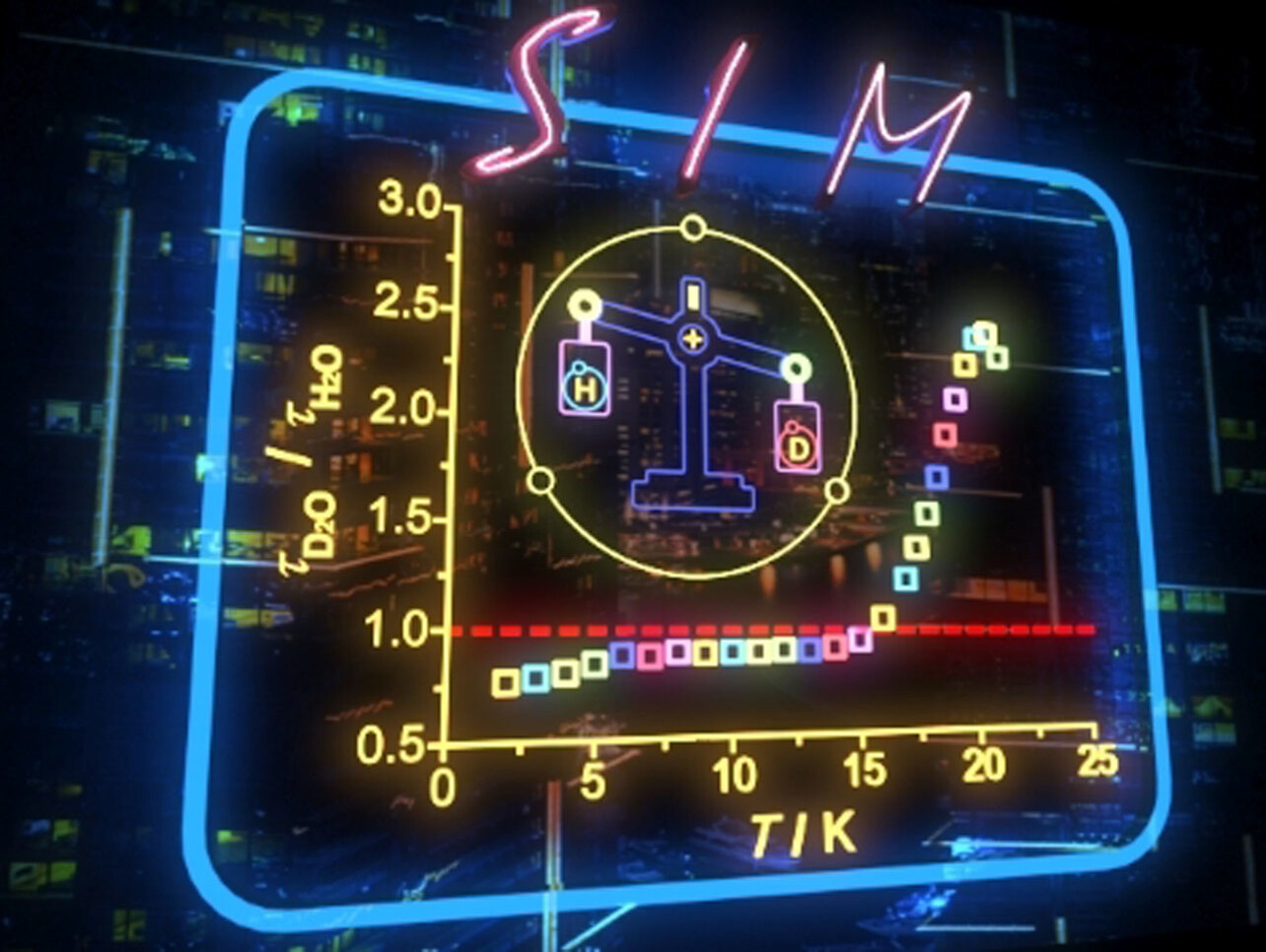
104. Magnetization Dynamics on Isotope-Isomorphic Holmium Single-Molecule Magnets
Abstract
Here we reported the deuteration of the metal-binding equatorial water molecules in a reported HoIII single-molecule magnet (SMM) with pentagonal-bipyramidal geometry, from [Ho(CyPh2PO)2(H2O)5]3+ to [Ho(CyPh2PO)2(D2O)5]3+. The hyperfine structures originating from the nuclear spin of 165HoIII can be clearly observed. Moreover, the resulting magnetization dynamics revealed the switch of the relative relaxation rates for the two isotope-isomorphic complexes—respectively faster/slower at low/high temperature. The noticeable isotope effect arises from not only the paramagnetic metal center but also the diamagnetic ligands, which can be explained by the ab initio calculated tunnel splitting and the involvement of the super-hyperfine interaction related to the difference in the nuclear spin number of protium (1H, I = 1/2) and deuterium (2H, I = 1).
103. Towards understanding the magnetism of Os(iv) complexes: an ab initio insight
Abstract
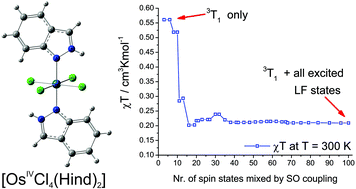
The magnetism of a recently synthesized trans-[OsIVCl4(κN1-Hind)2] complex (5d4-system), where Hind = 2H-indazole, was studied experimentally and theoretically. Relativistic CASSCF/CASPT2 calculations for this and model [OsIVCl6]2− complexes were employed to understand the nature of the low-lying multiplets. It is found that despite strong metal–ligand covalency they are basically characterized by the total angular pseudo-momentum J̃ originating from the spin–orbit coupling of the ground-state spin S = 1 with the orbital pseudo-momentum L̃ = 1 of the OsIV ion. The strong spin–orbit interaction also preserves the dominant J̃ = 0 character of the non-magnetic ground state in the trans-[OsIVCl4(κN1-Hind)2] complex despite significant deviation of the ligand environment of OsIV from octahedral symmetry. At the same time the spin–orbit admixture of all multiplets arising from the t2g4 strong-field electronic configuration is indispensable for the correct description of magnetic properties of OsIV complexes. Moreover, based on ab initio calculations, we argue that the charge-transfer states play an important role in the magnetism of the present and probably other 5d complexes, a situation never encountered for 3d and 4f compounds.
102. Exploring vibronic coupling in the benzene radical cation and anion with different levels of the GW approximation
Abstract
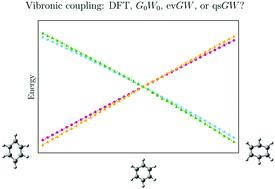
The linear vibronic coupling constants of the benzene radical cation and anion have been obtained with different levels of the GW approximation, including G0W0, eigenvalue self-consistent GW, and quasiparticle self-consistent GW, as well as DFT with the following exchange–correlation functionals: BLYP, B3LYP, CAM-B3LYP, tuned CAM-B3LYP, and an IP-tuned CAM-B3LYP functional. The vibronic coupling constants were calculated numerically using the gradients of the eigenvalues of the degenerate HOMOs and LUMOs of the neutral benzene molecule for DFT, while the numerical gradients of the quasiparticle energies were used in the case of GW. The results were evaluated against those of high level wave function methods in the literature, and the approximate self-consistent GW methods and G0W0 with long-range corrected functionals were found to yield the best results on the whole.
101. Design of FeIII–LnIII binuclear complexes using compartmental ligands: synthesis, crystal structures, magnetic properties, and ab initio analysis
Abstract
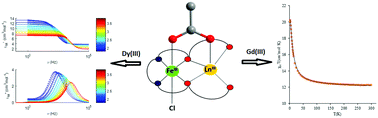
Three new binuclear FeIII–LnIII complexes, with similar structures, have been synthesized using the end-off compartmental proligand, H2valpn, resulting from the Schiff condensation between o-vanillin and 1,3-propylenediamine: [FeIIILnIII(valpn)(hfac)2(OAc)Cl] (Ln = Gd, Tb, Dy; hfac− = hexafluoroacetylacetonate; AcO− = acetate). The metal ions are triply bridged by two phenoxido oxygen atoms and by the acetato ligand (syn–syn bridging mode). Among all these compounds the FeIII–LnIII exchange interaction was found to be ferromagnetic (JFeGd = +1.004(4) cm-1; H = −JSFeSGd). The [FeIIIDyIII] derivative shows field-induced slow relaxation of the magnetization. The interpretation of the magnetic properties for the [FeIIIGdIII], [FeIIITbIII] and [FeIIIDyIII] is done through ab initio calculations. It was concluded that the temperature behavior of the relaxation time in the [FeIIIDyIII] derivative is due to dominant Orbach relaxation processes between states at the opposite sides and opposite heights of the blocking barrier. From this understanding, the relaxation mechanism for similar systems where a transition metal is in exchange coupling with a strong anisotropic lanthanide ion is elucidated, which could provide a strategy to synthesize other binuclear complexes with better magnetic properties.
100. A Family of Lanthanide Hydroxo Carboxylates with 1D Polymeric Topology and Ln4 Butterfly Core Exhibits Switchable Supramolecular Arrangement
Abstract
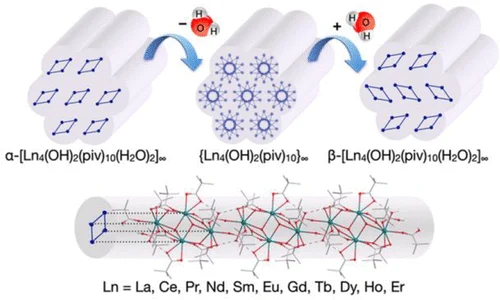
The unique family of coordination polymers [Ln4(OH)2(piv)10(H2O)2]∞ of 11 lanthanides (Ln = La-Er) has been prepared by a simple solution method based on controlled hydrolysis. The ribbon-like polymeric structure consisting of connected tetranuclear clusters and supported by pivalate ligands and a framework of H-bonds has been revealed by single-crystal X-ray diffraction. While the compounds demonstrate similar PXRD patterns and unit cell parameters, the joint single-crystal XRD and pair distribution function data suggest the significant local structure change along the lanthanide series. The compounds exist as two packing polymorphs (α and β) with similar ribbon geometry, but different supramolecular arrangement of the ribbons. Dehydration of either polymorph does not disturb the tetranuclear core but leads to a translational symmetry loss along the ribbon and a transformation of the 3D-ordered crystal into a 2D-ordered mesostructure. Rehydration of the mesostructure leads to the β polymorph (except La and Ce), allowing the deliberate switching between the polymorphs via dehydration-rehydration evidenced by means of powder X-ray diffraction, pair distribution function analysis, and density functional theory calculations. Ab initio calculations reveal significant magnetic anisotropy of Ln3+ ions with ferro- and antiferromagnetic interactions within tetranuclear [Ln4(OH)2(piv)10(H2O)2] species. Magnetic susceptibility measurements demonstrated antiferromagnetic coupling, slow magnetic relaxation for Dy, Ho, and Er complexes, and field-induced single-chain magnetism for the Dy compound.
99. Understanding the magnetization blocking mechanism in N23- -radical-bridged dilanthanide single-molecule magnets
Abstract
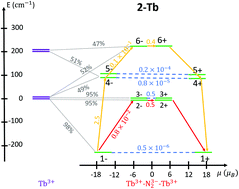
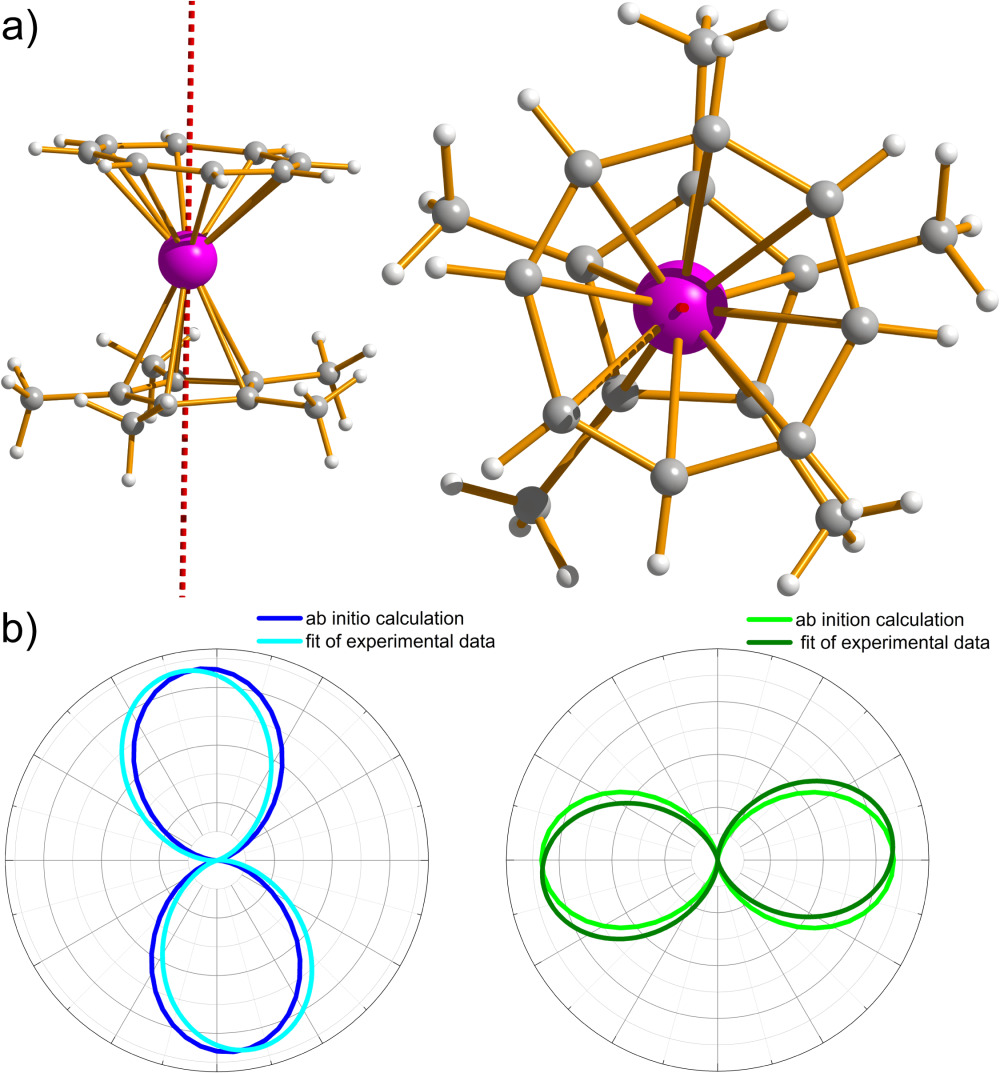
Herein, we report a theoretical investigation of the electronic structure and magnetic properties in [(CpMe4H2Ln(THF))2(μ-N2•)]− and [(CpMe4H2Ln)2(μ-N2•)]− (THF = tetrahydrofuran, CpMe4H = tetramethylcyclopentadienyl, Ln = Tb, Dy) complexes [as reported in Demir et al., Nat. Commun., 8, 1–9, 2144 (2017)]. By ab initio methods, their magnetic blocking behaviors are successfully characterized allowing elucidation of the origin of the two blocking barriers observed experimentally. In addition, a detailed analysis of exchange wave functions explains why the blocking barrier of the Tb complexes is roughly twice as large as that of the Dy analogues, a fact which appears to be a general trend exhibited in this family of compounds.
2020
98. Multiresponsive Spin Crossover Driven by Rotation of Tetraphenylborate Anion in an Iron(III) Complex
Abstract
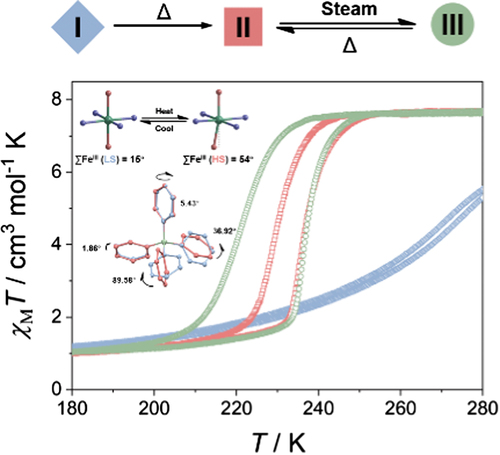
Dynamic molecular materials, which involve mechanical motions in crystals, usually exhibit tunable properties related to conformational polymorphs. Herein, we describe a solvent-free molecular crystal [{FeIII(salten)}2(TPB)](BPh4)2 (I) developed by associating the rotatable tetraphenylborate anion with the spin crossover (SCO) binuclear iron(III) cation. The solvent-free phase I can undergo a temperature-induced phase transformation to phase II, during which rotation of the BPh4- anion interplays with the SCO component, giving rise to fascinating variations in SCO (from gradual to abrupt) and dielectric properties. Most importantly, an unexpected polymorphic transformation from II to III or IV, with increasing magnetic hysteresis, is realized by exposing II to water or ethanol vapor; the transition is reversible by heating. This rare successive transformation is further rationalized by theoretical calculations. Hence, this multiresponse system provides a new way for modulating synergistic effects and designing dynamic SCO materials by integrating intramolecular motions in the crystal lattice.
97. Deriving the vibronic coupling constants of the cyclopentadienyl radical with density functional theory and G W
Abstract
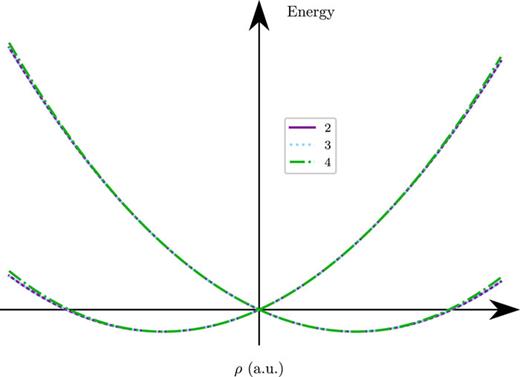
The vibronic coupling constants of the cyclopentadienyl radical have been calculated with G0W0, HF, and density functional theory (DFT) with various exchange-correlation functionals such as PBE, PBE0, LC-ωPBE, and the non-empirically tuned LC-ωPBE∗. The vibronic coupling constants for HF and DFT were derived using the gradients of the eigenvalues of the degenerate HOMOs of the closed-shell cyclopentadienyl anion, while the gradients of the corresponding quasiparticle energy levels were used in the case of G0W0. The differences between the linear vibronic constants obtained using HF and DFT were found to be small and reduced further when the G0W0 correction is applied to HF and DFT. Finally, the linear vibronic coupling constants calculated with G0W0 were found to agree well with the values obtained using high level wave function methods in the literature, which suggests that G0W0 can be a useful tool toward the study of vibronic coupling.
96. Highly Oxidized States of Phthalocyaninato Terbium(III) Multiple-Decker Complexes Showing Structural Deformations, Biradical Properties and Decreases in Magnetic Anisotropy
Abstract
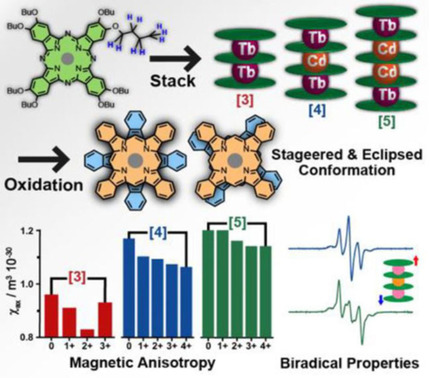
Presented here is a comprehensive study of highly oxidized multiple-decker complexes composed of TbIII and CdII ions and two to five phthalocyaninato ligands, which are stabilized by electron-donating n-butoxy groups. From X-ray structural analyses, all the complexes become axially compressed upon ligand oxidation, resulting in bowl-shaped distortions of the ligands. In addition, unusual coexistence of square antiprism and square prism geometries around metal ions was observed in +4e charged species. From paramagnetic 1H NMR studies on the resulting series of triple, quadruple and quintuple-decker complexes, ligand oxidation leads to a decrease in the magnetic anisotropy, as predicted from theoretical calculations. Unusual paramagnetic shifts were observed in the spectra of the +2e charged quadruple and quintuple-decker complexes, indicating that those two species are actually unexpected triplet biradicals. Magnetic measurements revealed that the series of complexes show single-molecule magnet properties, which are controlled by the multi-step redox induced structural changes.
95. Modern quantum chemistry with [Open]Molcas
![Graphical abstract for Modern quantum chemistry with [Open]Molcas](assets/publications/2020/OpenMolcas_JCP_2020.png)
Abstract
MOLCAS/OpenMolcas is an ab initio electronic structure program providing a large set of computational methods from Hartree–Fock and density functional theory to various implementations of multiconfigurational theory. This article provides a comprehensive overview of the main features of the code, specifically reviewing the use of the code in previously reported chemical applications as well as more recent applications including the calculation of magnetic properties from optimized density matrix renormalization group wave functions.
94. Coexistence of Spin–Lattice Relaxation and Phonon-Bottleneck Processes in GdIII –Phthlocyaninato Triple-Decker Complexes under Highly Diluted Conditions

Abstract
Gd3+ complexes have been shown to undergo unusual slow magnetic relaxation processes similar to those of single-molecule magnets (SMMs), even though Gd3+ does not exhibit strong magnetic anisotropy. To reveal the origin of the slow magnetic relaxation of Gd3+ complexes, we have investigated the magnetic properties and heat capacities of two Gd3+-phthalocyaninato triple-decker complexes, one of which has intramolecular Gd3+–Gd3+ interactions and the other does not. It was found that the Gd3+–Gd3+ interactions accelerate the magnetic relaxation processes. In addition, magnetically diluted samples, prepared by doping a small amount of the Gd3+ complexes into a large amount of diamagnetic Y3+ complexes, underwent dual magnetic relaxation processes. A detailed dynamic magnetic analysis revealed that the coexistence of spin–lattice relaxation and phonon-bottleneck processes is the origin of the dual magnetic relaxation processes.
93. Single-Molecule Toroic Design through Magnetic Exchange Coupling
Abstract
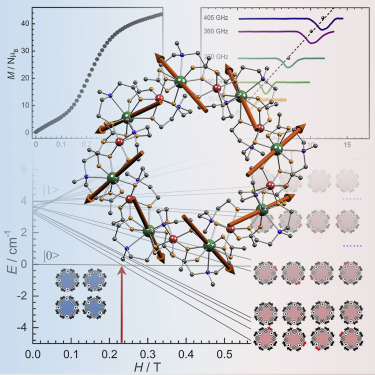
Toroidal molecular magnets represent promising candidates for next-generation ultra-dense information storage. These wheel-like molecules are able to store one bit per molecule because of their insensitivity to homogeneous magnetic fields—one of the main sources of magnetic perturbations. However, synthesis of molecules possessing a well-defined and stable vortex arrangement of the on-site magnetic moments in the ground state represents a challenge. Here, we show that 16 magnetic metal ions can be alternately arranged into a macrocycle named {Fe8Dy8}. The net toroidal moment can be experimentally determined at 0.23 Tesla. Moreover, ab initio calculations were performed to reveal that ferromagnetic exchange interactions between the FeIII and DyIII metal centers are the key to generate this toroidal moment. This feature is significantly distinguished from the previously described dipole-dipole interactionbased single-molecule toroics (SMTs), showing the importance of exchange-coupling interactions in the design of next-generation SMTs.
92. Magnetic Anisotropy in Divalent Lanthanide Compounds
Abstract
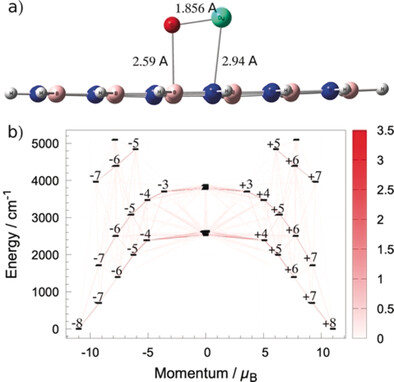
Complexes of trivalent lanthanides (Ln) are known to possess strong magnetic anisotropy, which enables them to be efficient single-molecule magnets. High-level ab initio calculations are reported for [LnO] (where Ln is terbium (Tb), dysprosium (Dy), or holmium (Ho)), which show that divalent lanthanides can exhibit equally strong magnetic anisotropy and magnetization blocking barriers. In particular, detailed calculations predict a multilevel magnetization blocking barrier exceeding 3000 K for a [DyO] complex deposited on a hexagonal boron nitride (h-BN) surface, bringing the expected performance of single-molecule magnets to a qualitatively new level compared to the current state-of-the art complexes.
91. An Inconspicuous Six-Coordinate Neutral DyIII Single-Ion Magnet with Remarkable Magnetic Anisotropy and Stability
Abstract
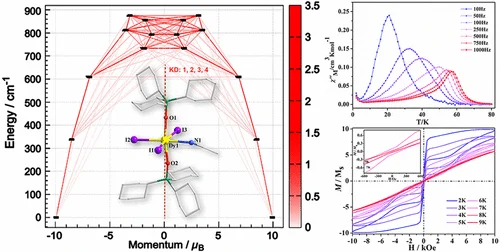
It is a crucial challenge to address both magnetic anisotropy and stability for single-molecule magnets (SMMs) used in next-generation nanodevices. Highly axial lanthanide SMMs with neutral charge and moderate coordination numbers represent promising magnetic materials. Here, using iodide ions with large volume and low surface charge density as weak donors, we report a six-coordinate neutral dysprosium SMM [Dy(Cy3PO)2I3(CH3CN)] with a certain degree of stability exhibiting a huge thermal barrier of 1062 K and hysteresis loops open up to 9 K. Through the elaborate reduction of ligand field strength, an apparent strongly axial crystal field is provided which elicits prominent crystal-field splitting and high axiality with the thermally activated relaxation via the third-excited Kramers' doublet. Moreover, the profound influence of strong equatorial ligand substitution on the electronic structure and relaxation pathway is clearly explored in DyIII analogues. The result suggests the great potential of the reducing the transverse ligand field in the improvement of SMMs performance.
2019
90. Comparison of two field-induced ErIII single ion magnets
Abstract
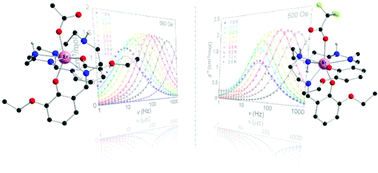
We present the synthesis, magnetic and photophysical properties of four mononuclear LnIII complexes in two isostructural lattices containing GdIII and ErIII. A heptadentate Schiff base ligand and acetate versus trifluoroacetate were used to synthesise complexes 1–4, among which the two ErIII complexes 2 and 4 exhibit field-induced SIM behaviour with almost similar Ueff values (31.6 K for 2 and 32.7 K for 4). Ab initio calculations show the structure of the low-lying energy states and highlight that there is already significant tunnelling in the ground doublet state, but the application of a weak magnetic field of 0.05 T is sufficient for ac magnetic measurements to suppress tunnelling in the ground state. The calculated main magnetic axes (gZ) of the ground Kramers doublets show small differences between the two ErIII compounds 2 and 4 due to their different ligand fields.
89. OpenMolcas: From Source Code to Insight
Abstract
In this Article we describe the OpenMolcas environment and invite the computational chemistry community to collaborate. The open-source project already includes a large number of new developments realized during the transition from the commercial MOLCAS product to the open-source platform. The paper initially describes the technical details of the new software development platform. This is followed by brief presentations of many new methods, implementations, and features of the OpenMolcas program suite. These developments include novel wave function methods such as stochastic complete active space selfconsistent field, density matrix renormalization group (DMRG) methods, and hybrid multiconfigurational wave function and density functional theory models. Some of these implementations include an array of additional options and functionalities. The paper proceeds and describes developments related to explorations of potential energy surfaces. Here we present methods for the optimization of conical intersections, the simulation of adiabatic and nonadiabatic molecular dynamics, and interfaces to tools for semiclassical and quantum mechanical nuclear dynamics. Furthermore, the Article describes features unique to simulations of spectroscopic and magnetic phenomena such as the exact semiclassical description of the interaction between light and matter, various X-ray processes, magnetic circular dichroism, and properties. Finally, the paper describes a number of built-in and add-on features to support the OpenMolcas platform with postcalculation analysis and visualization, a multiscale simulation option using frozen-density embedding theory, and new electronic and muonic basis sets.
88. Single Crystal Investigations Unravel the Magnetic Anisotropy of the “Square-In Square” Cr4Dy4 SMM Coordination Cluster
Abstract
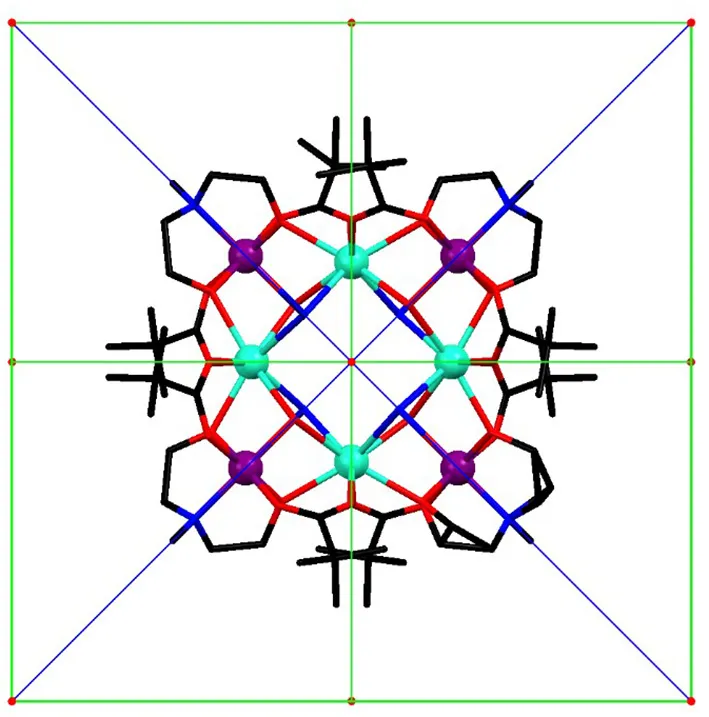
In the search for new single molecule magnets (SMM), i.e., molecular systems that can retain their magnetization without the need to apply an external magnetic field, a successful strategy is to associate 3d and 4f ions to form molecular coordination clusters. In order to efficiently design such systems, it is necessary to chemically project both the magnetic building blocks and the resultant interaction before the synthesis. Lanthanide ions can provide the required easy axis magnetic anisotropy that hampers magnetization reversal. In the rare examples of 3d/4f SMMs containing CrIII ions, the latter turn out to act as quasi-isotropic anchors which can also interact via 3d-4f coupling to neighbouring Ln centres. This has been demonstrated in cases where the intramolecular exchange interactions mediated by CrIII ions effectively reduce the efficiency of tunnelling without applied magnetic field. However, describing such high nuclearity systems remains challenging, from both experimental and theoretical perspectives, because the overall behaviour of the molecular cluster is heavily affected by the orientation of the individual anisotropy axes. These are in general non-collinear to each other. In this article, we combine single crystal SQUID and torque magnetometry studies of the octanuclear [Cr4Dy4(µ3-OH)4(µ-N3)4(mdea)4(piv)8]·3CH2Cl2 single molecule magnet (piv=pivalate and mdea=N-methyldiethanol amine). These experiments allowed us to probe the magnetic anisotropy of this complex which displays slow magnetization dynamics due to the peculiar arrangement of the easy-axis anisotropy on the Dy sites. New ab initio calculations considering the entire cluster are in agreement with our experimental results.
87. Determination of the electronic structure of a dinuclear dysprosium single molecule magnet without symmetry idealization
Abstract
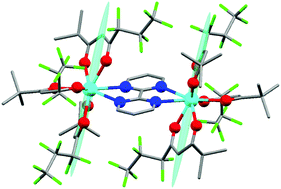
We present the in-depth determination of the magnetic properties and electronic structure of the luminescent and volatile dysprosium-based single molecule magnet [Dy2(bpm)(fod)6] (Hfod = 6,6,7,7,8,8,8-heptafluoro-2,2-dimethyl-3,5-octanedione, bpm = 2,2′-bipyrimidine). Ab initio calculations were used to obtain a global picture of the electronic structure and to predict possible single molecule magnet behaviour, confirmed by experiments. The orientation of the susceptibility tensor was determined by means of cantilever torque magnetometry. An experimental determination of the electronic structure of the lanthanide ion was obtained combining Luminescence, Far Infrared and Magnetic Circular Dichroism spectroscopies. Fitting these energies to the full single ion plus crystal field Hamiltonian allowed determination of the eigenstates and crystal field parameters of a lanthanide complex without symmetry idealization. We then discuss the impact of a stepwise symmetry idealization on the modelling of the experimental data. This result is particularly important in view of the misleading outcomes that are often obtained when the symmetry of lanthanide complexes is idealized.
2018
86. Magnetization Blocking in Fe2IIIDy2III Molecular Magnets: Ab Initio Calculations and EPR Spectroscopy
Abstract
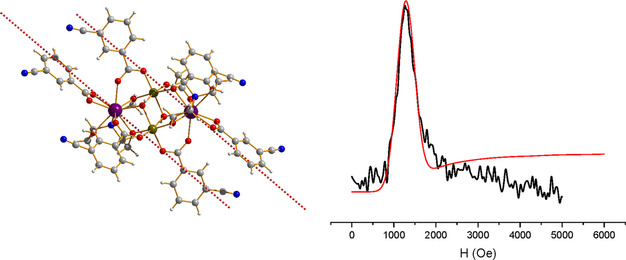
The magnetism and magnetization blocking of a series of [FeIII2DyIII2(OH)2(teaH)2(RC6H4COO)6] complexes was investigated, in which teaH3=triethanolamine and R=meta-CN (1), para-CN (2), meta-CH3 (3), para-NO2 (4) and para-CH3 (5), by combining ab initio calculations and EPR measurements. The results of broken-symmetry DFT calculations show that in all compounds the Fe–Fe exchange interaction is antiferromagnetic and stronger by far than the Fe–Dy and Dy–Dy interactions. As a result, the lowest two exchange doublets probed by EPR spectroscopy mostly originate from the Ising interaction of the dysprosium ions in all compounds. A correct quantitative description of the splitting of these two doublets requires, however, an explicit account of the Fe–Dy and Fe–Fe interactions. Due to the inversion symmetry of the complexes, the doublets under consideration are described by a collinear Ising exchange interaction. This picture is also supported by the EPR spectra, which could be simulated with parameters close to those extracted from the calculations. The magneto-structural analysis shows an increase of the antiferromagnetic Fe–Fe exchange interaction with increasing Fe-O-Fe angle and Fe–Fe distance. For the Dy–Fe interaction, the opposite tendency is observed, that is, a decrease of antiferromagnetic exchange coupling with increasing Dy-O-Fe angle and Dy–Fe distance. The transversal g factors extracted from the ab initio calculations have values in the range of 0.01–0.2, testifying to the lack of high axiality of the ground state of the dysprosium ions. This explains the lack/poor single-molecule magnetic behavior of this series of compounds at the investigated temperatures of a few Kelvin. Due to a very small gap (fractions of a wavenumber) between the ground and first-excited exchange doublet, relaxation takes place by magnetic moment reversal at individual dysprosium sites in the considered temperature domain.
85. J ̃ -pseudospin states and the crystal field of cubic systems
Abstract
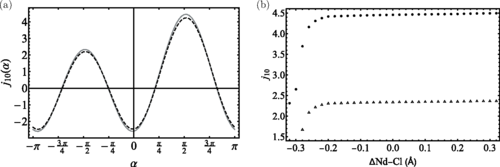
The theory of J̃ pseudospin for the f element in a cubic environment is developed. By fulfilling the symmetry requirements and the adiabatic connection to the atomic limit, the crystal-field states are uniquely transformed into J̃-pseudospin states. In terms of the pseudospin operators, both the total angular momentum and the crystal-field Hamiltonian contain higher-rank tensor terms than the traditional ones do, which means the present framework naturally includes effects such as covalency and J mixing beyond the f-shell model. Combining the developed theory with ab initio calculations, the J̃-pseudospin states for Nd3+ and Np4+ ions in octahedral sites of insulators are derived.
84. Gold-Catalyzed Post-Ugi Ipso-Cyclization with Switchable Diastereoselectivity
Abstract
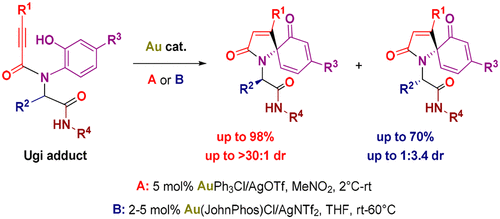
A gold-catalyzed post-Ugi ipso-cyclization for the diastereoselective synthesis of spirocyclic pyrrol-2-onedienone system is described. Tuning the catalytic system, solvent, and temperature allowed selectively attaining two sets of diastereoisomers. The scope of the process has been evaluated, and a putative mechanistic model was proposed.
83. Exchange Interactions Switch Tunneling: A Comparative Experimental and Theoretical Study on Relaxation Dynamics by Targeted Metal Ion Replacement
Abstract
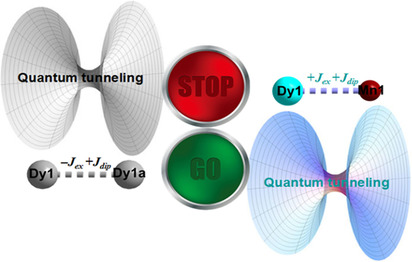
The magnetic relaxation and magnetization blocking barriers of tailor-made homo- and heterodinuclear compounds [Dy2(opch)2(OAc)2(H2O)2]⋅MeOH (1) and [DyMn(opch)2(OAc)(MeOH)(H2O)2] (2), where H2opch is (E)-N′-(2-hydroxy-3-methoxybenzylidene)pyrazine-2-carbohydrazide, were systematically investigated and the change in single-molecule magnet behavior originating from targeted replacement of one dysprosium site in the Dy2 compound with manganese was elucidated through a combination of experimental and theoretical studies. A detailed comparative study on these closely related model compounds revealed remarkable changes of the crystal-field splitting and anisotropy of the Dy site and the total exchange spectrum due to the replacement of Dy by Mn. The blocking barriers of these two compounds, which explain their different relaxation behaviors, were analyzed. The two Ising doublets arising from the magnetic interaction in the case of 1 are strongly uniaxial, with tunneling splittings smaller than 10-6 cm-1, and this leads to magnetic relaxation at temperatures exceeding the exchange energy (2.14 cm-1), which involves transition via the excited states corresponding to local transitions on the excited doublet at the Dy site. The third and fourth exchange doublets in 2 (located at 2.16 and 3.25 cm-1, respectively) show much larger tunneling splittings (of 10-4 and 10-3 cm-1, respectively), and thus open an important path for magnetic relaxation.
82. Exchange coupling and single molecule magnetism in redox-active tetraoxolene-bridged dilanthanide complexes
Abstract
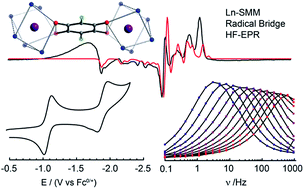
Tetraoxolene radical-bridged lanthanide SMM systems were prepared for the first time by reduction of the respective neutral compounds. Magnetic measurements reveal the profound influence of the radical center on magnetic behavior. Strong magnetic couplings are revealed in the radical species, which switch on SMM behavior under zero applied field for DyIII and TbIII compounds. HFEPR spectra unravel the contributions of the magnetic coupling and the magnetic anisotropy. For GdIII this results in much more accurate magnetic coupling parameters with respect to bulk magnetic measurements.
81. Introduction to the electronic structure, luminescence, and magnetism of lanthanides
Abstract
This introductory chapter describes theoretical tools and methods employed for the description of the optical and magnetic properties of lanthanide compounds. First, we introduce the electronic structure of the free lanthanide ions in gas phase, a multiplet structure with an overview of the effect of the ligand (crystal) environment on the low-lying multiplets. Second, crystal and ligand field theories applied in this field are briefly introduced together with their grounds and drawbacks. The foundations of the Judd–Ofelt theory describing the intensities of the optical transitions in lanthanide compounds are discussed. Recent advances in the ab initio theoretical methods used for the description of lanthanide complexes are introduced. Further, theoretical requirements for top-performant molecular magnets are reviewed alongside a brief review of the recent top-performant molecular magnets obtained experimentally. Finally, a personal opinion regarding the future (theoretical) work that needs to be done in this area is given.
2017
80. Zeeman interaction and Jahn-Teller effect in the Γ 8 multiplet
Abstract
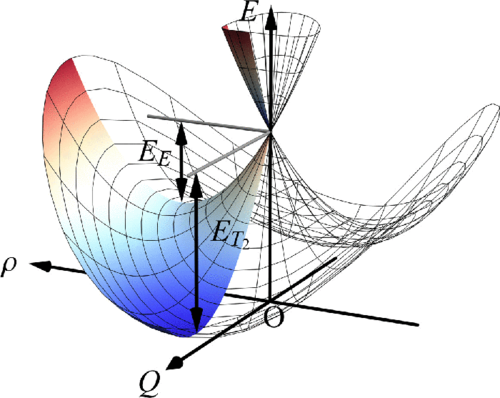
We present a thorough analysis of the interplay of magnetic moment and the Jahn-Teller effect in the Γ8 cubic multiplet. We find that in the presence of the dynamical Jahn-Teller effect, the Zeeman interaction remains isotropic, whereas the g and G factors can change their signs. The static Jahn-Teller distortion also can change the sign of these g factors as well as the nature of the magnetic anisotropy. Combining the theory with state-of-the-art ab initio calculations, we analyzed the magnetic properties of Np4+ and Ir4+ impurity ions in a cubic environment. The calculated g factors of the Np4+ impurity agree well with experimental data. The ab initio calculation predicts a strong Jahn-Teller effect in Ir4+ ion in the cubic environment and the strong vibronic reduction of g and G factors.
79. Strong ferromagnetic exchange coupling in a {NiII4} cluster mediated through an air-stable tetrazine-based radical anion
Abstract
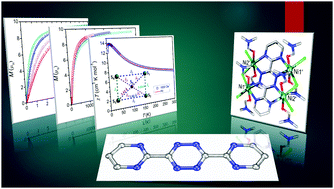
A planar tetradentate 3,6-bis(2-pyrimidyl)-1,2,4,5-tetrazine (BpymTz) templating chelate affords the formation of an unprecedented BpymTz˙− radical anion bridged {NiII4} complex. Detailed magnetic measurements performed on the isolated air stable [NiII4(BpymTz˙−)Cl6(DMF)8]Cl·0.5(H2O) compound reveal strong ferromagnetic NiII–BpymTz˙− interactions with a coupling constant of J = 98.84 cm-1.
78. Dynamic Magnetic and Optical Insight into a High Performance Pentagonal Bipyramidal DyIII Single-Ion Magnet
Abstract
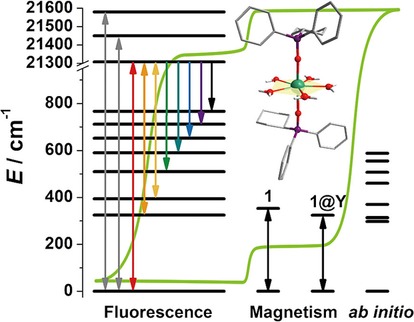
The pentagonal bipyramidal single-ion magnets (SIMs) are among the most attractive prototypes of high-performance single-molecule magnets (SMMs). Here, a fluorescence-active phosphine oxide ligand CyPh2PO (=cyclohexyl(diphenyl)phosphine oxide) was introduced into [Dy(CyPh2PO)2(H2O)5]Br3⋅2(CyPh2PO)⋅EtOH⋅3H2O, and combined dynamic magnetic measurement, optical characterization, ab initio calculation, and magneto-optical correlation of this high-performance pseudo-D5h DyIII SIM with large Ueff (508(2) K) and high magnetic hysteresis temperature (19 K) were performed. This work provides a deeper insight into the rational design of promising molecular magnets.
77. Ab Initio Crystal Field for Lanthanides
Abstract
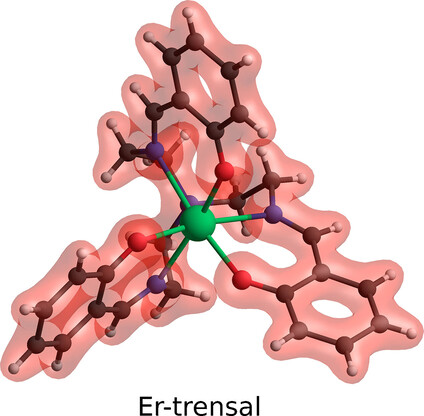
An ab initio methodology for the first-principle derivation of crystal-field (CF) parameters for lanthanides is described. The methodology is applied to the analysis of CF parameters in [Tb(Pc)2]− (Pc=phthalocyanine) and Dy4K2 ([Dy4K2O(OtBu)12]) complexes, and compared with often used approximate and model descriptions. It is found that the application of geometry symmetrization, and the use of electrostatic point-charge and phenomenological CF models, lead to unacceptably large deviations from predictions based on ab initio calculations for experimental geometry. It is shown how the predictions of standard CASSCF (Complete Active Space Self-Consistent Field) calculations (with 4f orbitals in the active space) can be systematically improved by including effects of dynamical electronic correlation (CASPT2 step) and by admixing electronic configurations of the 5d shell. This is exemplified for the well-studied Er-trensal complex (H3trensal=2,2′,2“-tris(salicylideneimido)trimethylamine). The electrostatic contributions to CF parameters in this complex, calculated with true charge distributions in the ligands, yield less than half of the total CF splitting, thus pointing to the dominant role of covalent effects. This analysis allows the conclusion that ab initio crystal field is an essential tool for the decent description of lanthanides.
76. Pursuit of Record Breaking Energy Barriers: A Study of Magnetic Axiality in Diamide Ligated DyIII Single-Molecule Magnets
Abstract
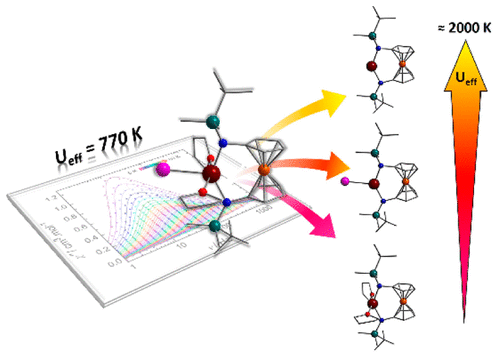
DyIII single-ion magnets (SIMs) with strong axial donors and weak equatorial ligands are attractive model systems with which to harness the maximum magnetic anisotropy of DyIII ions. Utilizing a rigid ferrocene diamide ligand (NNTBS), a DyIII SIM, (NNTBS)DyI(THF)2, 1-Dy (NNTBS = fc(NHSitBuMe2)2, fc = 1,1′-ferrocenediyl), composed of a near linear arrangement of donor atoms, exhibits a large energy barrier to spin reversal (770.8 K) and magnetic blocking (14 K). The effects of the transverse ligands on the magnetic and electronic structure of 1-Dy were investigated through ab initio methods, eliciting significant magnetic axiality, even in the fourth Kramers doublet, thus demonstrating the potential of rigid diamide ligands in the design of new SIMs with defined magnetic axiality.
75. Cycloheptatrienyl trianion: an elusive bridge in the search of exchange coupled dinuclear organolanthanide single-molecule magnets
Abstract
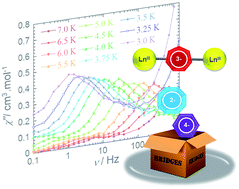
The preparation of η-cyclopentadienyl (η5-C5R5), η-arene (η6-C6R6), and η-cyclooctatetraenyl (η8-C8R8) bridging motifs are common in organometallic chemistry; however, the synthetic preparation of η-cycloheptatrienyl (η7-C7R7) bridging motifs has remained a synthetic challenge in 4f chemistry. To this end, we have developed a synthetic route towards a series of rare dinuclear organolanthanide inverse sandwich complexes containing the elusive η7-C7H7 bridge. Herein, we present the structures and magnetic properties of the lanthanide inverse sandwich complexes [KLn2(C7H7)(N(SiMe3)2)4] (Ln = GdIII (1), DyIII (2), ErIII (3)) and [K(THF)2Er2(C7H7)(N(SiMe3)2)4] (4). These compounds are the first single-molecule magnets (SMMs) to feature this type of bridging motif. Furthermore, η7-C7H7 was found to efficiently promote ferromagnetic exchange interactions between metal ions. Variable temperature dc magnetic susceptibility measurements and subsequent simulations give significant exchange constants of J = +1.384, +1.798, and +3.149 cm-1 and dipolar constants of J = −0.603, −0.601, and −0.475 cm-1 for compounds 2–4, respectively. Frequency dependent ac susceptibility measurements under an applied static field resulted in the observation of dual relaxation processes, and brought forth a greater understanding of the intermolecularly driven process at high frequency. In particular, this type of analysis of compound 3 under 800 Oe elicited an energy barrier of Ueff = 58 K. Ab initio calculations were performed in order to understand the nature of magnetic coupling and the origin of slow relaxation of magnetisation. Through these studies, the effect of the amido ancillary ligands on the magnetic axiality of the lanthanide ions was found to be competitive with the crystal field of the η7-C7H7 π-electron cloud. Our findings suggest that the tunability of the dipolar and exchange components of the magnetic interactions lie within the dihedral angle imposed by the amido ligands, thus offering potential for the development of new exchange coupled lanthanide systems.
2016
74. Synthesis, Crystal Structures, Magnetic Properties, and Theoretical Investigation of a New Series of NiII –LnIII –WV Heterotrimetallics: Understanding the SMM Behavior of Mixed Polynuclear Complexes
Abstract
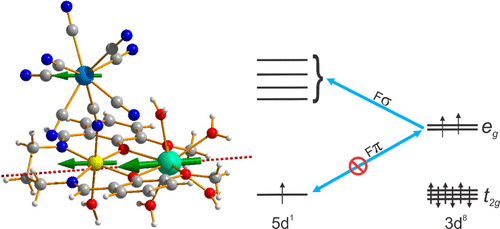
The polynuclear compounds containing anisotropic metal ions often exhibit efficient barriers for blocking of magnetization at fairly arbitrary geometries. However, at variance with mononuclear complexes, which usually become single-molecule magnets (SMM) under the sole requirement of a highly axial crystal field at the metal ion, the factors influencing the SMM behavior in polynuclear complexes, especially, with weakly axial magnetic ions, still remain largely unrevealed. As an attempt to clarify these conditions, we present here the synthesis, crystal structures, magnetic behavior, and ab initio calculations for a new series of NiII-LnIII-WV trimetallics, [(CN)7W(CN)Ni(H2O)(valpn)Ln(H2O)4]·H2O (Ln = Y 1, Eu 2, Gd 3, Tb 4, Dy 5, Lu 6). The surprising finding is the absence of the magnetic blockage even for compounds involving strongly anisotropic DyIII and TbIII metal ions. This is well explained by ab initio calculations showing relatively large transversal components of the g-tensor in the ground exchange Kramers doublets of 1 and 4 and large intrinsic tunneling gaps in the ground exchange doublets of 3 and 5. In order to get more insight into this behavior, another series of earlier reported compounds with the same trinuclear [WVNiIILnIII] core structure, [(CN)7W(CN)Ni(dmf)(valdmpn)Ln(dmf)4]·H2O (Ln = GdIII 7, TbIII 8a, DyIII 9, HoIII 10), [(CN)7W(CN)Ni(H2O)(valdmpn)Tb(dmf)2.5(H2O)1.5]·H2O·0.5dmf 8b, and [(CN)7W(CN)Ni(H2O)(valdmpn)Er(dmf)3(H2O)1]·H2O·0.5dmf 11, has been also investigated theoretically. In this series, only 8b exhibits SMM behavior which is confirmed by the present ab initio calculations. An important feature for the entire series is the strong ferromagnetic coupling between NiII and WV, which is due to an almost perfect trigonal dodecahedron geometry of the octacyano wolframate fragment. The reason why only 8b is an SMM is explained by positive zero-field splitting on the nickel site, precluding magnetization blocking in complexes with fewer axial Ln ions. Further analysis has shown that, in the absence of ZFS on Ni ion, all compounds in the two series (except those containing Y and Gd) would be SMMs. The same situation arises for perfectly axial ZFS on NiII with the main anisotropy axis parallel to the main magnetic axis of LnIII ions. In all other cases the ZFS on NiII will worsen the SMM properties. The general conclusion is that the design of efficient SMMs on the basis of such complexes should involve isotropic or weekly anisotropic metal ions, such as MnII, FeIII, etc., along with strongly axial lanthanides.
73. Strategies toward High-Temperature Lanthanide-Based Single-Molecule Magnets
Abstract
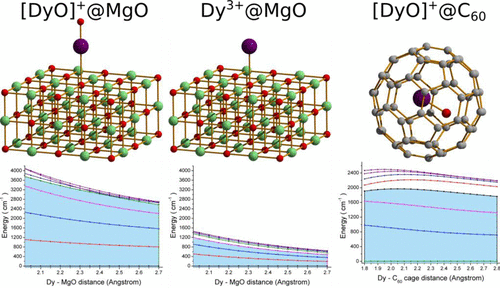
Lanthanide-based single-molecule magnets are leading materials for achieving magnetization blocking at the level of one molecule. In this paper, we examine the physical requirements for efficient magnetization blocking in single-ion complexes and identify the design principles for achieving very high magnetization blocking barriers in lanthanide-based compounds. The key condition is the preponderant covalent binding of the Ln ion to one of the ligand atoms, tremendously enhancing the axial crystal field. We also make an overview of practical schemes for the implementation of this principle. These are (1) the effective lowering of the coordination number via displacement of the Ln ion to one of the atoms in the coordination polyhedron, (2) the design of two-coordinated complexes, and (3) the stabilization of diatomic compounds in cages and on surfaces. The last proposal is appealing in connection to spintronics applications, especially via the exploration of robust and highly anisotropic [LnX] units displaying multilevel blocking barriers of thousands of Kelvin and prospects for room-temperature magnetization blocking.
72. The active site of low-temperature methane hydroxylation in iron-containing zeolites
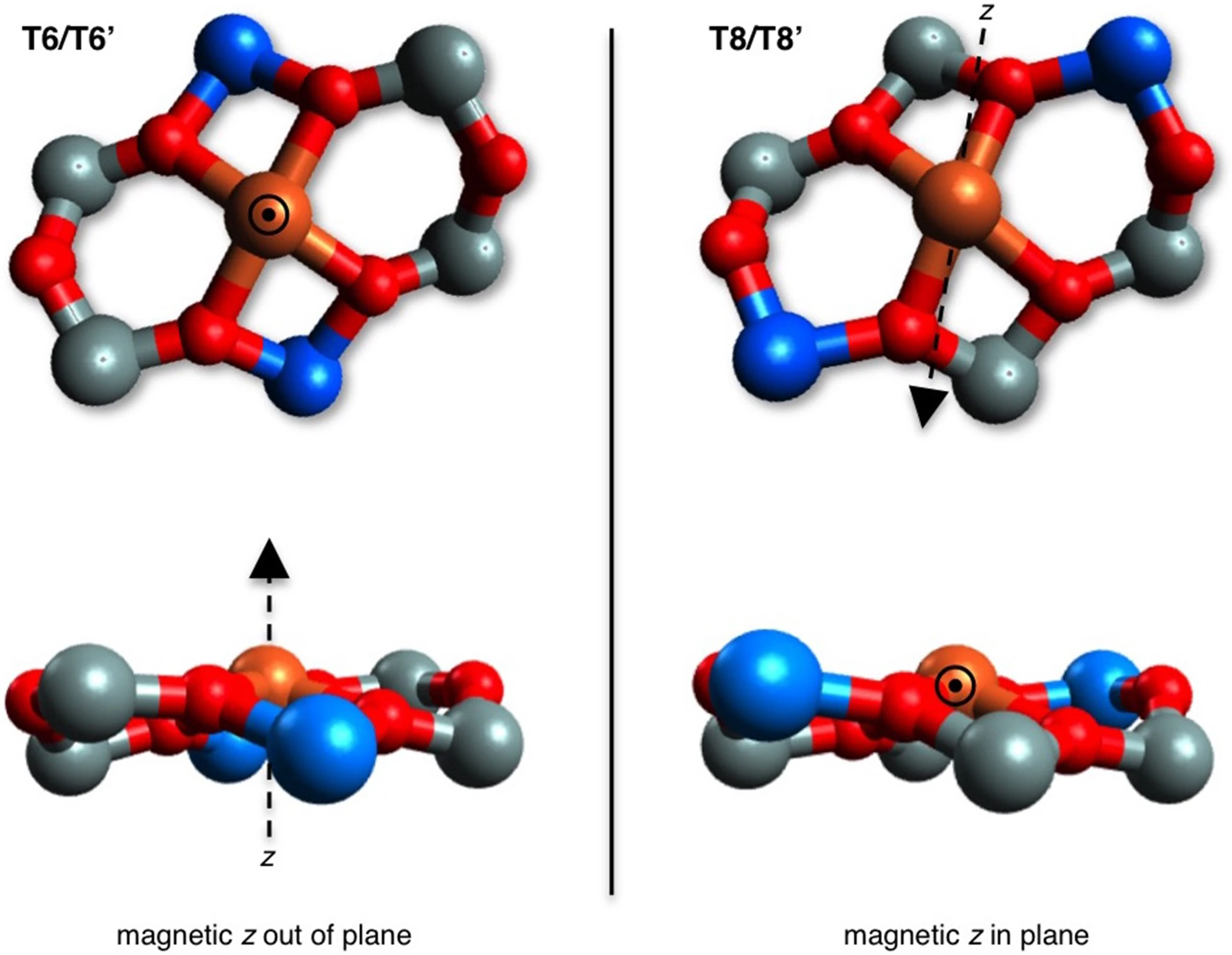
Abstract
An efficient catalytic process for converting methane into methanol could have far-reaching economic implications. Iron-containing zeolites (microporous aluminosilicate minerals) are noteworthy in this regard, having an outstanding ability to hydroxylate methane rapidly at room temperature to form methanol. Reactivity occurs at an extra-lattice active site called α-Fe(ii), which is activated by nitrous oxide to form the reactive intermediate α-O; however, despite nearly three decades of research, the nature of the active site and the factors determining its exceptional reactivity are unclear. The main difficulty is that the reactive species—α-Fe(ii) and α-O—are challenging to probe spectroscopically: data from bulk techniques such as X-ray absorption spectroscopy and magnetic susceptibility are complicated by contributions from inactive ‘spectator’ iron. Here we show that a site-selective spectroscopic method regularly used in bioinorganic chemistry can overcome this problem. Magnetic circular dichroism reveals α-Fe(ii) to be a mononuclear, high-spin, square planar Fe(ii) site, while the reactive intermediate, α-O, is a mononuclear, high-spin Fe(iv)=O species, whose exceptional reactivity derives from a constrained coordination geometry enforced by the zeolite lattice. These findings illustrate the value of our approach to exploring active sites in heterogeneous systems. The results also suggest that using matrix constraints to activate metal sites for function—producing what is known in the context of metalloenzymes as an ‘entatic’ state—might be a useful way to tune the activity of heterogeneous catalysts.
71. A Stable Pentagonal Bipyramidal Dy(III) Single-Ion Magnet with a Record Magnetization Reversal Barrier over 1000 K
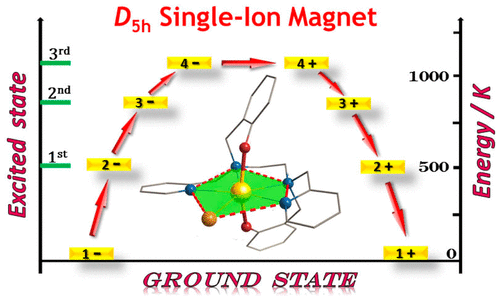
Abstract
Single-molecule magnets (SMMs) with a large spin reversal barrier have been recognized to exhibit slow magnetic relaxation that can lead to a magnetic hysteresis loop. Synthesis of highly stable SMMs with both large energy barriers and significantly slow relaxation times is challenging. Here, we report two highly stable and neutral DyIII classical coordination compounds with pentagonal bipyramidal local geometry that exhibit SMM behavior. Weak intermolecular interactions in the undiluted single crystals are first observed for mononuclear lanthanide SMMs by micro-SQUID measurements. The investigation of magnetic relaxation reveals the thermally activated quantum tunneling of magnetization through the third excited Kramers doublet, owing to the increased axial magnetic anisotropy and weaker transverse magnetic anisotropy. As a result, pronounced magnetic hysteresis loops up to 14 K are observed, and the effective energy barrier (Ueff = 1025 K) for relaxation of magnetization reached a breakthrough among the SMMs.
70. Giant exchange interaction in mixed lanthanides
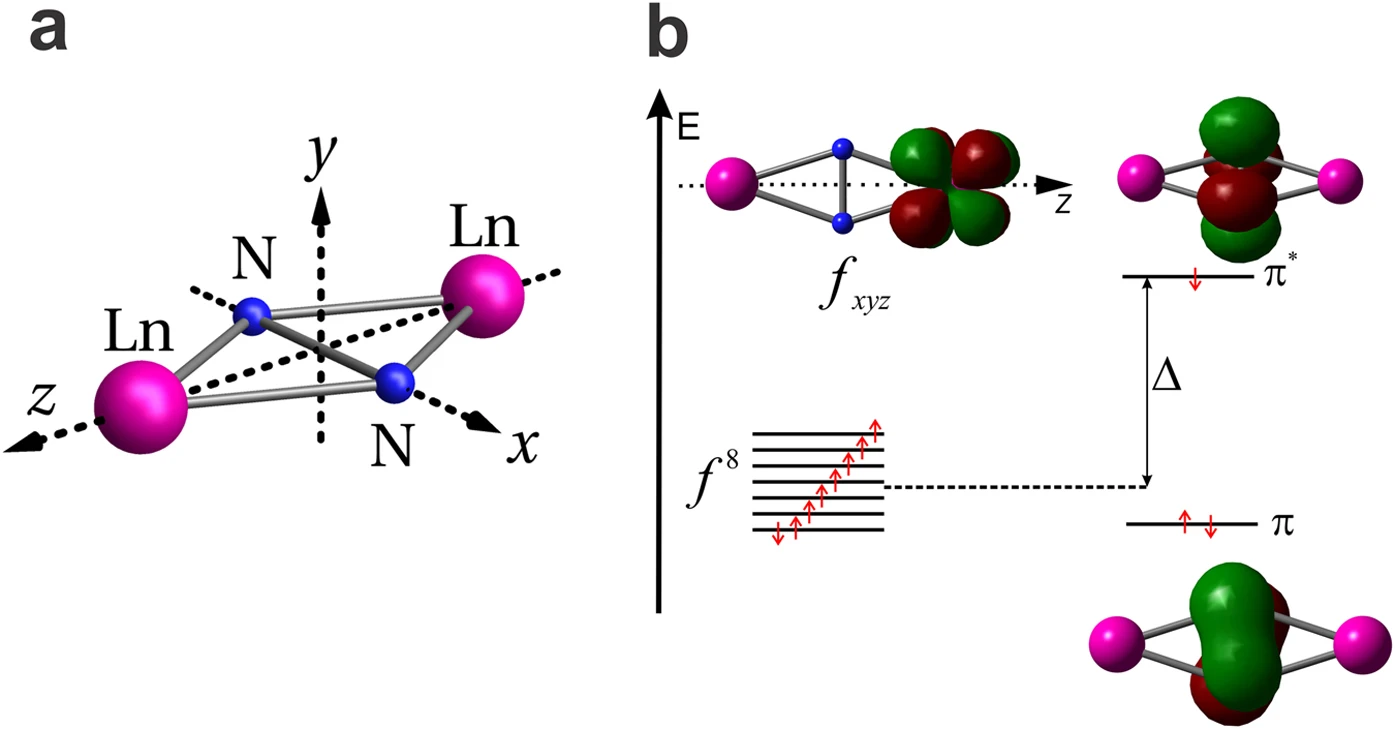
Abstract
Combining strong magnetic anisotropy with strong exchange interaction is a long standing goal in the design of quantum magnets. The lanthanide complexes, while exhibiting a very strong ionic anisotropy, usually display a weak exchange coupling, amounting to only a few wavenumbers. Recently, an isostructural series of mixed (Ln = Gd, Tb, Dy, Ho, Er) have been reported, in which the exchange splitting is estimated to reach hundreds wavenumbers. The microscopic mechanism governing the unusual exchange interaction in these compounds is revealed here by combining detailed modeling with density-functional theory and ab initio calculations. We find it to be basically kinetic and highly complex, involving non-negligible contributions up to seventh power of total angular momentum of each lanthanide site. The performed analysis also elucidates the origin of magnetization blocking in these compounds. Contrary to general expectations the latter is not always favored by strong exchange interaction.
69. Symmetry-Supported Magnetic Blocking at 20 K in Pentagonal Bipyramidal Dy(III) Single-Ion Magnets
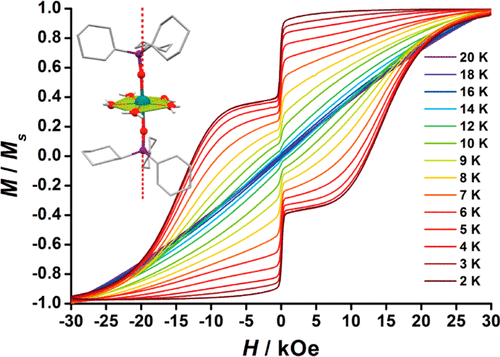
Abstract
Single-molecule magnets (SMMs) that can be trapped in one of the bistable magnetic states separated by an energy barrier are among the most promising candidates for high-density information storage, quantum processing, and spintronics. To date, a considerable series of achievements have been made. However, the presence of fast quantum tunnelling of magnetization (QTM) in most SMMs, especially in single-ion magnets (SIMs), provides a rapid relaxation route and often sets up a limit for the relaxation time. Here, we pursue the pentagonal bipyramidal symmetry to suppress the QTM and present pentagonal bipyramidal DyIII SIMs [Dy(Cy3PO)2(H2O)5]Cl3·(Cy3PO)·H2O·EtOH (1) and [Dy(Cy3PO)2(H2O)5]Br3·2(Cy3PO)·2H2O·2EtOH (2), (Cy3PO = tricyclohexyl phosphine oxide). Magnetic characterizations reveal their fascinating SMM properties with high energy barriers as 472(7) K for 1 and 543(2) K for 2, along with a record magnetic hysteresis temperature up to 20 K for 2. These results, combined with the ab initio calculations, offer an illuminating insight into the vast possibility and potential of what the symmetry rules can achieve in molecular magnetism.
68. Molcas 8: New capabilities for multiconfigurational quantum chemical calculations across the periodic table
Abstract
In this report, we summarize and describe the recent unique updates and additions to the Molcas quantum chemistry program suite as contained in release version 8. These updates include natural and spin orbitals for studies of magnetic properties, local and linear scaling methods for the Douglas–Kroll–Hess transformation, the generalized active space concept in MCSCF methods, a combination of multiconfigurational wave functions with density functional theory in the MC-PDFT method, additional methods for computation of magnetic properties, methods for diabatization, analytical gradients of state average complete active space SCF in association with density fitting, methods for constrained fragment optimization, large-scale parallel multireference configuration interaction including analytic gradients via the interface to the Columbus package, and approximations of the CASPT2 method to be used for computations of large systems. In addition, the report includes the description of a computational machinery for nonlinear optical spectroscopy through an interface to the QM/MM package Cobramm. Further, a module to run molecular dynamics simulations is added, two surface hopping algorithms are included to enable nonadiabatic calculations, and the DQ method for diabatization is added. Finally, we report on the subject of improvements with respects to alternative file options and parallelization. © 2015 Wiley Periodicals, Inc.
67. Multitechnique investigation of Dy3 – implications for coupled lanthanide clusters
Abstract
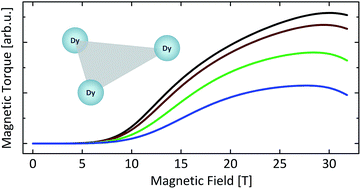
In-depth investigations of the low energy electronic structures of mononuclear lanthanide complexes, including single molecule magnets, are challenging at the best of times. For magnetically coupled polynuclear systems, the task seems well nigh impossible. However, without detailed understanding of the electronic structure, there is no hope of understanding their static and dynamic magnetic properties in detail. We have been interested in assessing which techniques are most appropriate for studying lanthanide single-molecule magnets. Here we present a wide ranging theoretical and experimental study of the archetypal polynuclear lanthanide single-molecule magnet Dy3 and derive the simplest model to describe the results from each experimental method, including high-frequency electron paramagnetic resonance and far-infrared spectroscopies and cantilever torque magnetometry. We conclude that a combination of these methods together with ab initio calculations is required to arrive at a full understanding of the properties of this complex, and potentially of other magnetically coupled lanthanide complexes.
66. Probing the structural and magnetic properties of a new family of centrosymmetric dinuclear lanthanide complexes
Abstract
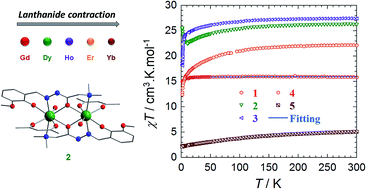
A series of centrosymmetric dinuclear lanthanide complexes, including GdIII (1), DyIII (2), HoIII (3), ErIII (4) and YbIII (5), have been synthesized and studied for the effects of lanthanide contraction on their magnetic properties. As a result of probing the magnetic properties of the GdIII analogue, 1, a weak antiferromagnetic intramolecular interaction was confirmed, with J = −0.01 cm-1 and g = 2.01. The DyIII complex, 2, was found to exhibit larger values of gx and gy in the ground doublet of individual DyIII ions via ab initio calculations, and thus did not act as a SMM. Interestingly, the ErIII (4) and YbIII (5) complexes exhibited slow relaxation of the magnetization under an applied dc field with effective energy barriers (Ueff) of 21 K and 22 K, respectively.
2015
65. Desolvation-Driven 100-Fold Slow-down of Tunneling Relaxation Rate in Co(II)-Dy(III) Single-Molecule Magnets through a Single-Crystal-to-Single-Crystal Process
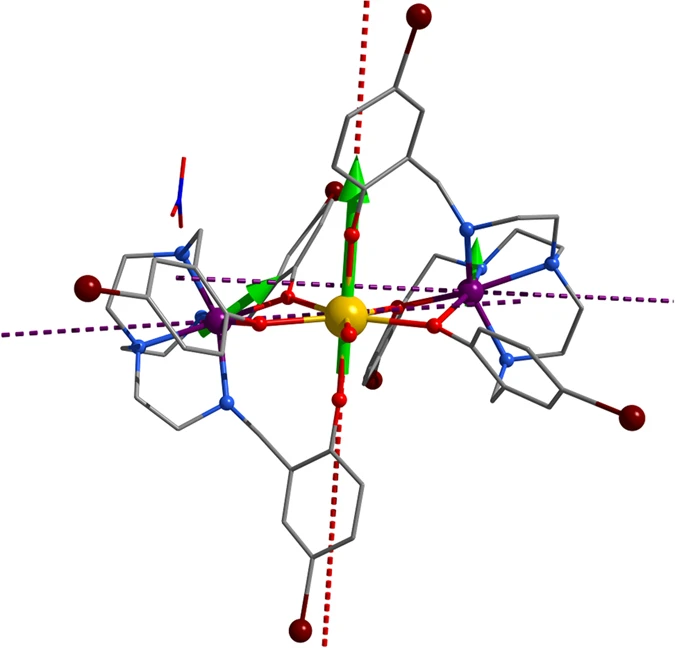
Abstract
Single-molecule magnets (SMMs) are regarded as a class of promising materials for spintronic and ultrahigh-density storage devices. Tuning the magnetic dynamics of single-molecule magnets is a crucial challenge for chemists. Lanthanide ions are not only highly magnetically anisotropic but also highly sensitive to the changes in the coordination environments. We developed a feasible approach to understand parts of the magneto-structure correlations and propose to regulate the relaxation behaviors via rational design. A series of CoII-DyIII-CoII complexes were obtained using in situ synthesis; in this system of complexes, the relaxation dynamics can be greatly improved, accompanied with desolvation, via single-crystal to single-crystal transformation. The effective energy barrier can be increased from 293 cm-1 (422 K) to 416 cm-1 (600 K) and the tunneling relaxation time can be grown from 8.5 × 10⁻⁴ s to 7.4 × 10⁻² s. These remarkable improvements are due to the change in the coordination environments of DyIII and CoII. Ab initio calculations were performed to better understand the magnetic dynamics.
64. Tuning the Magnetic Interactions and Relaxation Dynamics of Dy2 Single-Molecule Magnets
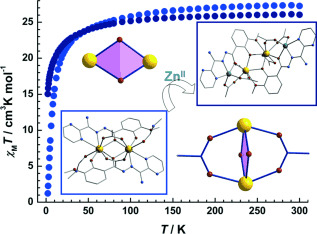
Abstract
Efficient modulation of single-molecule magnet (SMM) behavior was realized by deliberate structural modification of the Dy2 cores of [Dy2(a′povh)2(OAc)2(DMF)2] (1) and [Zn2Dy2(a′povh)2(OAc)6]⋅4H2O (2; H2a′povh=N′-[amino(pyrimidin-2-yl)methylene]-o-vanilloyl hydrazine). Compound 1 having fourfold linkage between the two dysprosium ions shows high-performance SMM behavior with a thermal energy barrier of 322.1 K, whereas only slow relaxation is observed for compound 2 with only twofold connection between the dysprosium ions. This remarkable discrepancy is mainly because of strong axiality in 1 due to one pronounced covalent bond, as revealed by experimental and theoretical investigations. The significant antiferromagnetic interaction derived from bis(μ2-O) and two acetate bridging groups was found to be crucial in leading to a nonmagnetic ground state in 1, by suppressing zero-field quantum tunneling of magnetization.
63. Magnetic Relaxation in Single-Electron Single-Ion Cerium(III) Magnets: Insights from Ab Initio Calculations
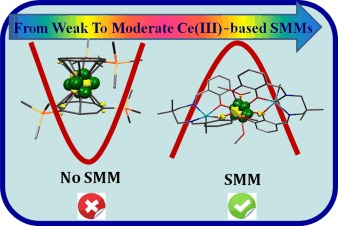
Abstract
Detailed ab initio calculations were performed on two structurally different cerium(III) single-molecule magnets (SMMs) to probe the origin of magnetic anisotropy and to understand the mechanism of magnetic relaxations. The complexes [CeIII{ZnII(L)}2(MeOH)]BPh4 (1) and [Li(dme)3][CeIII(cot″)2] (2; L=N,N,O,O-tetradentate Schiff base ligand; DME=dimethoxyethane, COT″=1,4-bis(trimethylsilyl)cyclooctatetraenyldianion), which are reported to be zero-field and field-induced SMMs with effective barrier heights of 21.2 and 30 K respectively, were chosen as examples. CASSCF+RASSI/SINGLE_ANISO calculations unequivocally suggest that mJ|±5/2〉 and |±1/2〉 are the ground states for complexes 1 and 2, respectively. The origin of these differences is rooted back to the nature of the ligand field and the symmetry around the cerium(III) ions. Ab initio magnetisation blockade barriers constructed for complexes 1 and 2 expose a contrasting energy-level pattern with significant quantum tunnelling of magnetisation between the ground state Kramers doublet in complex 2. Calculations performed on several model complexes stress the need for a suitable ligand environment and high symmetry around the cerium(III) ions to obtain a large effective barrier.
62. Influencing the properties of dysprosium single-molecule magnets with phosphorus donor ligands
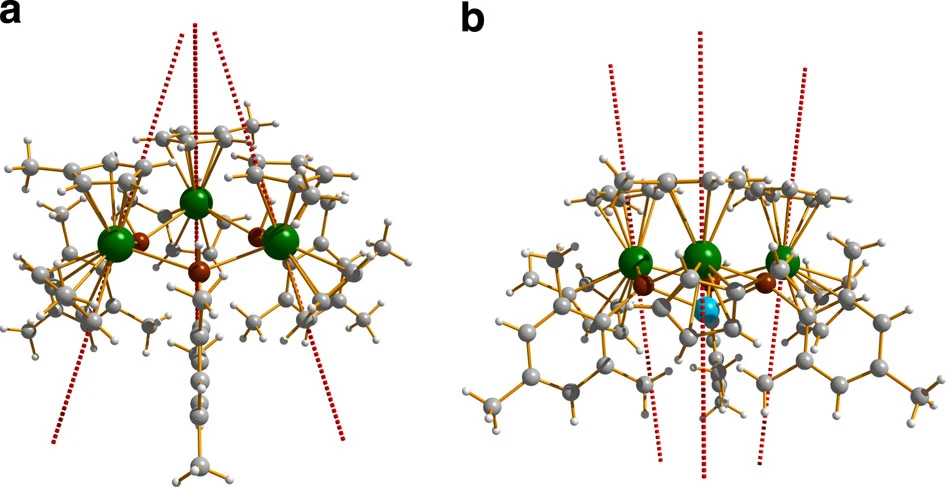
Abstract
Single-molecule magnets are a type of coordination compound that can retain magnetic information at low temperatures. Single-molecule magnets based on lanthanides have accounted for many important advances, including systems with very large energy barriers to reversal of the magnetization, and a di-terbium complex that displays magnetic hysteresis up to 14 K and shows strong coercivity. Ligand design is crucial for the development of new single-molecule magnets: organometallic chemistry presents possibilities for using unconventional ligands, particularly those with soft donor groups. Here we report dysprosium single-molecule magnets with neutral and anionic phosphorus donor ligands, and show that their properties change dramatically when varying the ligand from phosphine to phosphide to phosphinidene. A phosphide-ligated, trimetallic dysprosium single-molecule magnet relaxes via the second-excited Kramers' doublet, and, when doped into a diamagnetic matrix at the single-ion level, produces a large energy barrier of 256 cm-1 and magnetic hysteresis up to 4.4 K.
61. Heterometallic 3d–4f Single-Molecule Magnets: Ligand and Metal Ion Influences on the Magnetic Relaxation
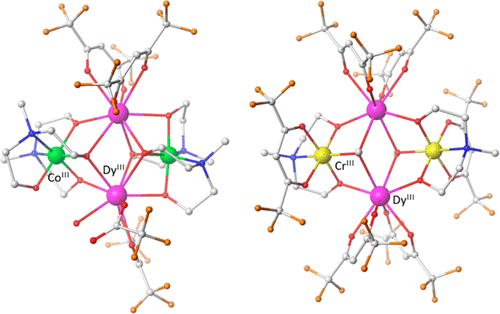
Abstract
Six tetranuclear 3d-4f single-molecule magnet (SMM) complexes formed using N-n-butyldiethanolamine and N-methyldiethanolamine in conjunction with ortho- and para-substituted benzoic acid and hexafluoroacetoacetone ligands yield two families, both having a butterfly metallic core. The first consists of four complexes of type {CoIII2CoIIDyIII2} and {CoIII2CoIICoIIDyIII} using N-n-butyldiethanolamine with variation of the carboxylate ligand. The anisotropy barriers are 80 cm-1, (77 and 96 cm-1—two relaxation processes occur), 117 and 88 cm-1, respectively, each following a relaxation mechanism from a single DyIII ion. The second family consists of a {CoIII2CoIIDyIII2} and a {CrIII2CoIIDyIII2} complex, from the ligand combination of N-methyldiethanolamine and hexafluoroacetylacetone. Both show SMM behavior, the CoIII example displaying an anisotropy barrier of 23 cm-1. The CrIII complex displays a barrier of 28 cm-1, with longer relaxation times and open hysteresis loops, the latter of which is not seen in the CoIII case. This is a consequence of strong DyIII-CrIII magnetic interactions, with the relaxation arising from the electronic structure of the whole complex and not from a single DyIII ion. The results suggest that the presence of strong exchange interactions lead to significantly longer relaxation times than in isostructural complexes where the exchange is weak. The study also suggests that electron-withdrawing groups on both bridging (carboxylate) and terminal (β-diketonate) ligands enhance the anisotropy barrier.
60. Tetraanionic Biphenyl Lanthanide Complexes as Single-Molecule Magnens
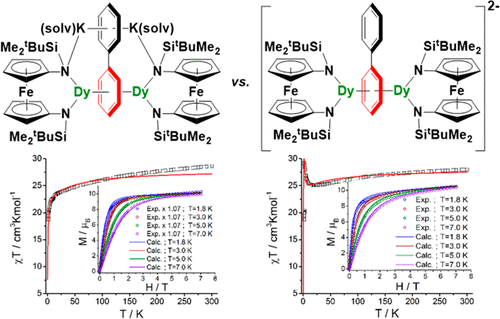
Abstract
Inverse sandwich biphenyl complexes [(NNTBS)Ln]2(μ-biphenyl)[K(solvent)]2 [NNTBS = 1,1'-fc(NSitBuMe2)2; Ln = Gd, Dy, Er; solvent = Et2O, toluene; 18-crown-6], containing a quadruply reduced biphenyl ligand, were synthesized and their magnetic properties measured. One of the dysprosium biphenyl complexes was found to exhibit antiferromagnetic coupling and single-molecule-magnet behavior with Ueff of 34 K under zero applied field. The solvent coordinated to potassium affected drastically the nature of the magnetic interaction, with the other dysprosium complex showing ferromagnetic coupling. Ab initio calculations were performed to understand the nature of magnetic coupling between the two lanthanide ions bridged by the anionic arene ligand and the origin of single-molecule-magnet behavior.
59. Observation of unusual slow-relaxation of the magnetisation in a Gd-EDTA chelate
Abstract
A Gadolinium EDTA chelate displays characteristic isotropic behaviour common of GdIII complexes under zero applied magnetic field, and anisotropic behaviour arising from dipolar coupling and weak spin–phonon coupling under an applied magnetic field. This surprising magnetic behaviour for GdIII is investigated using SQUID magnetometry and rationalized through theoretical calculations.
58. Computational Modelling of the Magnetic Properties of Lanthanide Compounds
Abstract
This chapter revises several findings and insights in the field of lanthanide molecular magnetism obtained with the ab initio approach. It gives a short review of the key points of the computational scheme suitable for the description of electronic structure in lanthanides. Currently there are two approaches for (partial) account of dynamical correlation to a multiconfigurational complete active space self-consistent field (CASSCF) wave function: (i) perturbative and (ii) configuration interaction (CI) methods. Two-component DFT methods aim at solving the reduced form of the four component Dirac equation using DFT formalism. A prominent feature of polynuclear lanthanide complexes, which distinguishes them from transition metal (TM) complexes, is their noncollinear magnetic structure. The magnetic structure in the ground exchange multiplets of mixed compounds is richer than in pure lanthanide complexes and depends on the nature of TM ions and on the relative orientations of the main magnetic axes on Ln ions.
2014
57. Field-Induced Multiple Relaxation Mechanism of CoIII2DyIII Compound with the Dysprosium Ion in a Low-Symmetrical Environment
Abstract
A defective cubane-shaped heterometallic trinuclear CoIII2DyIII compound with only one magnetically interesting ion (DyIII) has been assembled by virtue of a multifunctional acylhydrazone ligand. Because of the nonaxial ground state of DyIII ion derived from a low-symmetrical crystal field, the title compound displays field-induced multiple relaxation processes which are of molecular and a dipolar-dipolar coupling origin, as revealed by combined experimental and theoretical investigations. The results demonstrate that such a mononuclear dysprosium(III) compound with a low-symmetrical environment of magnetic center appears to be a model system for further investigations to shed light on the complex relaxation mechanism of lanthanide-based single ion magnets.
56. A Heterometallic FeII –DyIII Single-Molecule Magnet with a Record Anisotropy Barrier
Abstract
A record anisotropy barrier (319 cm-1) for all d-f complexes was observed for a unique FeII-DyIII-FeII single-molecule magnet (SMM), which possesses two asymmetric and distorted FeII ions and one quasi-D5h DyIII ion. The frozen magnetization of the DyIII ion leads to the decreased FeII relaxation rates evident in the Mössbauer spectrum. Ab initio calculations suggest that tunneling is interrupted effectively thanks to the exchange doublets.
55. Single-molecule toroics in Ising-type lanthanide molecular clusters
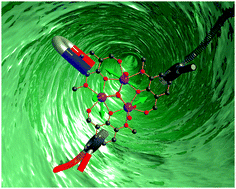
Abstract
Single-molecule toroics (SMTs) are defined, by analogy with single-molecule magnets, as bistable molecules with a toroidal magnetic state, and seem to be most promising for future applications in quantum computing and information storage and use as multiferroic materials with magnetoelectric effect. As an interdisciplinary research area that spans chemistry, physics and material sciences, synthetic chemists have produced systems suitable for detailed study by physicists and materials scientists, while ab initio calculations have been playing a major role in the detection of toroidal magnetization and the advancement of this field. In this tutorial review, we demonstrate the research developed in the fascinating and challenging field of molecular-based SMTs with particular focus on how recent studies tend to address the issue of toroidal arrangement of the magnetic moment in these systems. Herein, nine typical SMTs are summarized, showing that the assembly of wheel-shaped complexes with the high symmetry of the molecule unit and strong intra-molecular dipolar interactions using strong anisotropy metal ions represents the most promising route toward the design of a toroidal moment. Furthermore, the linkage of such robust toroidal moment units with ferromagnetic type through appropriate bridging ligands enhances the toroidal magnetic moment per unit cell.
54. Chemical tuning of the magnetic relaxation in dysprosium(iii) mononuclear complexes
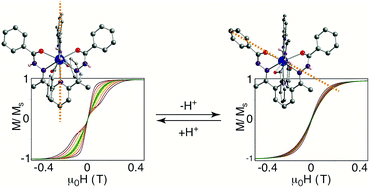
Abstract
A dysprosium(III) complex, exhibiting slow relaxation of magnetization, was prepared. Crystallographic studies showed a perturbation of local symmetry upon deprotonation of the ligand, with concomitant faster relaxation of magnetization. This was attributed to a large shift in the direction of the main magnetic axis, as indicated by ab initio calculations.
53. Electronic Structure and Slow Magnetic Relaxation of Low-Coordinate Cyclic Alkyl(amino) Carbene Stabilized Iron(I) Complexes
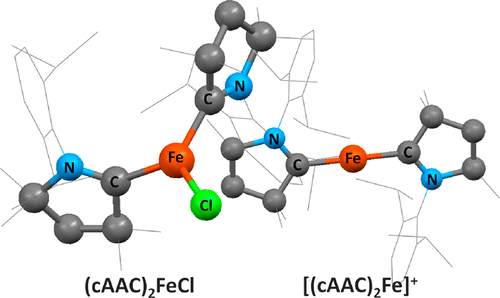
Abstract
Cyclic alkyl(amino) carbene stabilized two- and three-coordinate Fe(I) complexes, (cAAC)2FeCl (2) and [(cAAC)2Fe][B(C6F5)4] (3), respectively, were prepared and thoroughly studied by a bouquet of analytical techniques as well as theoretical calculations. Magnetic susceptibility and Mössbauer spectroscopy reveal the +1 oxidation state and S = 3/2 spin ground state of iron in both compounds. 2 and 3 show slow magnetic relaxation typical for single molecule magnets under an applied direct current magnetic field. The high-frequency EPR measurements confirm the S = 3/2 ground state with a large, positive zero-field splitting (∼ 20.4 cm-1) and reveal easy plane anisotropy for compound 2. CASSCF/CASPT2/RASSI-SO ab initio calculations using the MOLCAS program package support the experimental results.
52. An NCN-pincer ligand dysprosium single-ion magnet showing magnetic relaxation via the second excited state
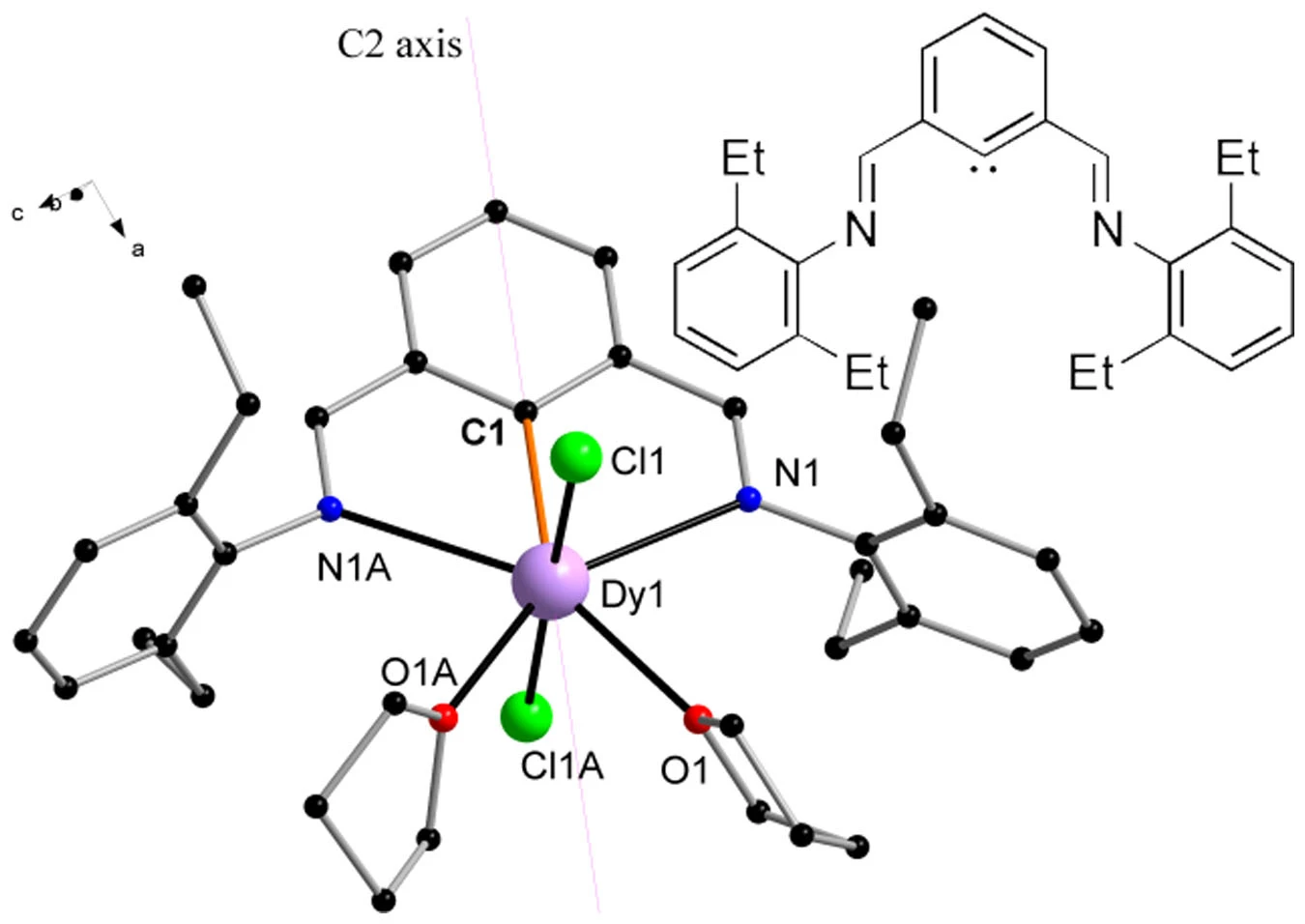
Abstract
Single-molecule magnets are compounds that exhibit magnetic bistability purely of molecular origin. The control of anisotropy and suppression of quantum tunneling to obtain a comprehensive picture of the relaxation pathway manifold, is of utmost importance with the ultimate goal of slowing the relaxation dynamics within single-molecule magnets to facilitate their potential applications. Combined ab initio calculations and detailed magnetization dynamics studies reveal the unprecedented relaxation mediated via the second excited state within a new DyNCN system comprising a valence-localized carbon coordinated to a single dysprosium(III) ion. The essentially C2v symmetry of the DyIII ion results in a new relaxation mechanism, hitherto unknown for mononuclear DyIII complexes, opening new perspectives for means of enhancing the anisotropy contribution to the spin-relaxation barrier.
51. Coupling Strategies to Enhance Single-Molecule Magnet Properties of Erbium–Cyclooctatetraenyl Complexes
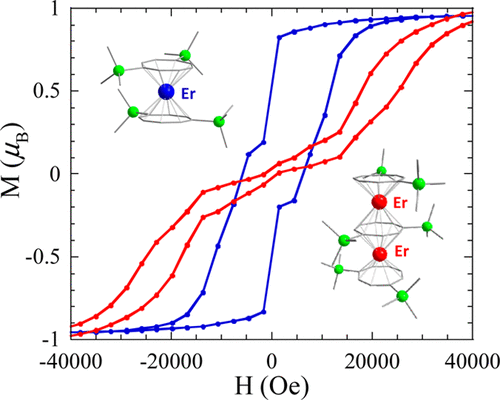
Abstract
Two different coupling strategies were employed to create ErIII single-molecule magnets (SMMs) using high blocking temperature mononuclear precursors. The magnetic properties of three lanthanide–COT complexes, [ErIII2(COT″)3] (1) (COT″ = 1,4-bis(trimethylsilyl)cyclooctatetraenyl dianion) and K2(THF)4[LnIII2(COT)4] (Ln = Gd (2), Er (3); THF = tetrahydrofuran, COT = cyclooctatetraenyl dianion), are reported. Both ErIII complexes behave as SMMs and exhibit magnetic hysteresis at 12 K in solid state. In solution compound 1 exhibits hysteresis up to 14 K. Ac susceptibility data indicates a 100 s blocking temperature of 12.5 and 12.9 K for [ErIII2(COT″)3] and K2(THF)4[ErIII2(COT)4], respectively. Both ErIII dimers display enhanced SMM properties over their mononuclear analogues due to their linear structure and strictly axial anisotropy. A 4 K increase in the magnetic blocking temperature of [ErIII2(COT″)3] over the double-decker analogue is attributed to an additional mechanism of magnetization blocking arising from exchange coupling between ErIII ions.
50. Single-Molecule Magnetism in a Family of {CoIII2DyIII2} Butterfly Complexes: Effects of Ligand Replacement on the Dynamics of Magnetic Relaxation
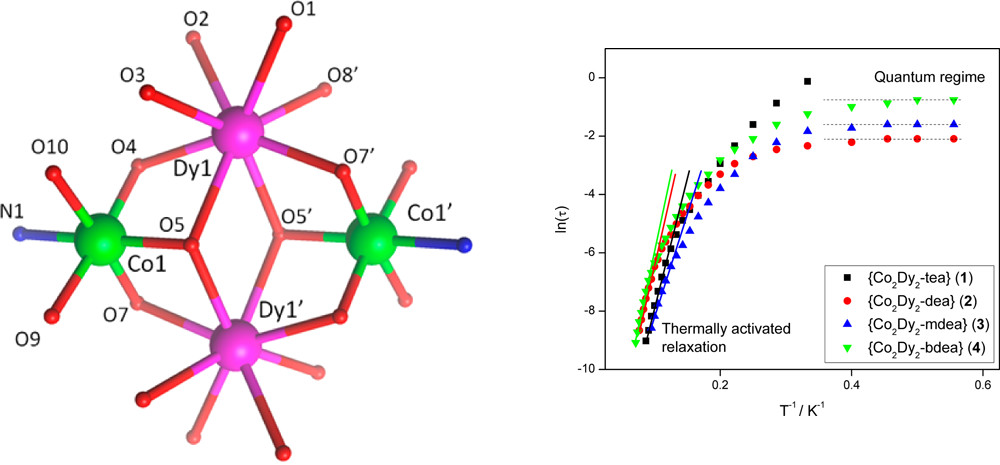
Abstract
The synthesis and structural characterization of four related heterometallic complexes of formulas [DyIII2CoIII2(OMe)2(teaH)2(O2CPh)4(MeOH)4](NO3)2·MeOH·H2O (1a) and [DyIII2CoIII2(OMe)2(teaH)2(O2CPh)4(MeOH)2(NO3)2]·MeOH·H2O (1b), [DyIII2CoIII2(OMe)2(dea)2(O2CPh)4(MeOH)4](NO3)2 (2), [DyIII2CoIII2(OMe)2(mdea)2(O2CPh)4(NO3)2] (3), and [DyIII2CoIII2(OMe)2(bdea)2(O2CPh)4(MeOH)4](NO3)2·0.5MeOH·H2O (4a) and [DyIII2CoIII2(OMe)2(bdea)2(O2CPh)4(MeOH)2(NO3)2]·MeOH·1.5H2O (4b) are reported (teaH3 = triethanolamine, deaH2 = diethanolamine, mdeaH2 = N-methyldiethanolamine, and bdeaH2 = N-n-butyldiethanolamine). Compounds 1 (≡ 1a and 1b) and 4 (≡ 4a and 4b) both display two unique molecules within the same crystal and all compounds display a butterfly type core, with the DyIII ions occupying the central body positions and the diamagnetic CoIII ions the outer wing-tip sites. Compounds 1–4 were investigated via direct current and alternating current magnetic susceptibility measurements, and it was found that each complex displayed single-molecule magnet (SMM) behavior. All four compounds display unique coordination and geometric environments around the DyIII ions and it was found that each displays a different anisotropy barrier. Ab initio calculations were performed on 1–4 and these determined the low lying electronic structure of each DyIII ion and the magnetic interactions for each cluster. It was found that there was a strong correlation between the calculated energy gap between the ground and first excited states of the single-ion ligand-field split DyIII levels and the experimentally observed anisotropy barrier. Furthermore, the transverse g factors found for the DyIII ions, defining the tunnelling rates within the ground Kramers doublets, are largest for 1, which agrees with the experimental observation of the shortest relaxation time in the high-temperature domain for this complex. The magnetic exchange between the DyIII ions revealed overall antiferromagnetic interactions for each compound, derived from the dominant dipolar exchange resulting in nonmagnetic ground states for 1–4. The diamagnetic ground states coupled with small tunneling gaps resulted in quantum tunneling time scales at zero field of between 0.1 and >1.5 s.
49. Fine-tuning the Local Symmetry to Attain Record Blocking Temperature and Magnetic Remanence in a Single-Ion Magnet
Abstract
Remanence and coercivity are the basic characteristics of permanent magnets. They are also tightly correlated with the existence of long relaxation times of magnetization in a number of molecular complexes, called accordingly single-molecule magnets (SMMs). Up to now, hysteresis loops with large coercive fields have only been observed in polynuclear metal complexes and metal-radical SMMs. On the contrary, mononuclear complexes, called single-ion magnets (SIM), have shown hysteresis loops of butterfly/phonon bottleneck type, with negligible coercivity, and therefore with much shorter relaxation times of magnetization. A mononuclear ErIII complex is presented with hysteresis loops having large coercive fields, achieving 7000 Oe at T = 1.8 K and field variation as slow as 1 h for the entire cycle. The coercivity persists up to about 5 K, while the hysteresis loops persist to 12 K. Our finding shows that SIMs can be as efficient as polynuclear SMMs, thus opening new perspectives for their applications.
48. Stabilization of a Cobalt–Cobalt Bond by Two Cyclic Alkyl Amino Carbenes
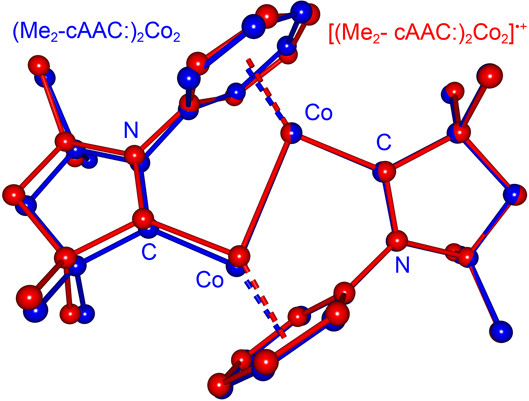
Abstract
Me2-cAAC:)2Co2 (2, where Me2-cAAC: = cyclic alkyl amino carbene, :C(CH2)(CMe2)2N-2,6-iPr2C6H3)) was synthesized via the reduction of precursor (Me2-cAAC:CoII(μ-Cl)Cl)2 (1) with KC8. 2 contains two cobalt atoms in the formal oxidation state zero. Magnetic measurement revealed that 2 has a singlet spin ground state S = 0. The cyclic voltammogram of 2 exhibits both one-electron oxidation and reduction, indicating the possible synthesis of stable species containing 2•- and 2•+ ions. The latter was synthesized via reduction of 1 with required equivalents of KC8 and characterized as [(Me2-cAAC:)2Co2]•+OTf- (2•+OTf-). Electron paramagnetic resonance spectroscopy of 2•+ reveals the coupling of the electron spin with 2 equiv 59Co isotopes, leading to a (Co0.5)2 state. The experimental Co1–Co2 bond distances are 2.6550(6) and 2.4610(6) Å for 2 and 2•+OTf-, respectively. Theoretical investigation revealed that both 2 and 2•+OTf- possess a Co–Co bond with an average value of 2.585 Å. A slight increase of the Co–Co bond length in 2 is more likely to be caused by the strong π-accepting property of cAAC. 2•+ is only 0.8 kcal/mol higher in energy than the energy minimum. The shortening of the Co–Co bond of 2•+ is caused by intermolecular interactions.
47. A Catalyst with Two-Coordinate Nickel: Theoretical and Catalytic Studies
Abstract
The bisadduct (cAAC)2NiIICl2 (1; cAAC = cyclic (alkyl)(amino)carbene) was directly synthesized by treating cAAC with NiCl2. Compound 1 was reduced to (cAAC)2Ni0 (2) by using lithium diisopropylamide or KC8. Crystals of 2 were stable under an inert gas for several months and decomposed upon heating above 165 °C. On the basis of the calculated natural bond orbital charge values of the nickel atom in 2, the oxidation state of nickel was determined to be between NiI and Ni0 (+0.34). Theoretical calculations suggested a closed-shell singlet electronic configuration of 2 with little biradical character. Ab initio multiconfigurational C(R)ASSCF/CASPT2 calculations predicted a closed-shell singlet electronic configuration (Ni0), whereas excited spin states possessed NiI character with unpaired electrons on neighboring carbon atoms. The catalytic activity of complex 2 was investigated for the homocoupling of various unactivated aryl chlorides/fluorides. The biaryls were obtained in good yields at moderate temperature. Theoretical studies showed that an intermediate containing NiIII was more favored than one with NiIV.
46. Spectroscopic determination of crystal field splittings in lanthanide double deckers
Abstract
We have investigated the crystal field splitting in the archetypal lanthanide-based single-ion magnets and related complexes (NBu4)+[LnPc2]−·2dmf (Ln = Dy, Ho, Er; dmf = N,N-dimethylformamide) by means of far infrared and inelastic neutron scattering spectroscopies. In each case, we have found several features corresponding to direct crystal field transitions within the ground multiplet. The observation of three independent peaks in the holmium derivative enabled us to derive crystal field splitting parameters. In addition, we have carried out CASSCF calculations. We show that exploiting the interplay of CASSCF calculation (for the composition of the states) and advanced spectroscopic measurements (for accurate determination of the energies) is a very powerful approach to gain insight into the electronic structure of lanthanide-based single-molecule magnets.
45. Modifying the properties of 4f single-ion magnets by peripheral ligand functionalisation
Abstract
We study the ligand-field splittings and magnetic properties of three ErIII single-ion magnets which differ in the peripheral ligand sphere but exhibit similar first coordination spheres by inelastic neutron scattering (INS) and SQUID magnetometry. The INS spectra of the three compounds are profoundly different pointing at a strong response of the magnetic behavior to minor structural changes, as they are e.g. encountered when depositing molecules on surfaces. The observation of several magnetic excitations within the J = 15/2 ground multiplet together with single-crystal magnetic measurements allows for the extraction of the sign and magnitude of all symmetry-allowed Stevens parameters. The parameter values and the energy spectrum derived from INS are compared to the results of state-of-the-art ab initio CASSCF calculations. Temperature-dependent alternating current (ac) susceptibility measurements suggest that the magnetisation relaxation in the investigated temperature range of 1.9 K < T < 5 K is dominated by quantum tunnelling of magnetisation and two-phonon Raman processes. The possibility of observing electron paramagnetic resonance transitions between the ground-state doublet states, which can be suppressed in perfectly axial single-ion magnets, renders the studied systems interesting as representations of quantum bits.
2013
44. Key Role of Frustration in Suppression of Magnetization Blocking in Single-Molecule Magnets
Abstract
State-of-the-art ab initio calculations of a series of endohedral fullerenes DynSc3-nN@C80 (n = 1, 2, 3) are performed, and their anisotropic magnetic properties are described from the first principles. Contrary to general expectation that molecules of higher nuclearity (n) exhibit better magnetic blocking properties, we predict Dy3N@C80 to be a relatively weak single-molecule magnet due to its frustrated ground state. This finding, relevant to polynuclear magnetic molecules in general, demonstrates the crucial role played by magnetic frustration in the suppression of magnetization blocking in single-molecule magnets.
43. Synthesis and Characterization of a Two-Coordinate Manganese Complex and its Reaction with Molecular Hydrogen at Room Temperature
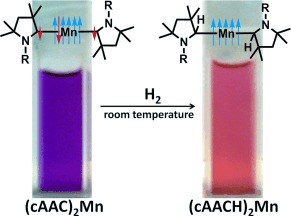
Abstract
The (cAAC)2Mn complex (cAAC=cyclic alkyl(amino)carbene) features a linear two-coordinate Mn center. The antiferromagnetic coupling of a radical electron, delocalized on two carbene C atoms, with the central MnI having d6 electronic configuration, mainly contributes to the ST=3/2 ground state. Treatment of (cAAC)2Mn with H2 at RT resulted in the addition of H atoms at both “carbene” C atoms, leaving the central Mn atom in the ST=5/2 spin ground state.
42. Angular-Resolved Magnetometry Beyond Triclinic Crystals: Out-of-Equilibrium Studies of Cp*ErCOT Single-Molecule Magnet
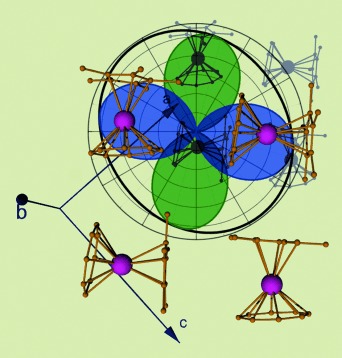
Abstract
Angular-resolved single-crystal magnetometry is a key tool to characterise lanthanide-based materials with low symmetry, for which conjectures based on idealised geometries can be totally misleading. Unfortunately the technique is strictly successful only for triclinic structures, thus reducing significantly its application. By collecting out-of-equilibrium magnetisation data the technique was extended to the orthorhombic organometallic Cp*ErCOT single-molecule magnet (SMM), thus allowing for the first time the reconstruction of the molecular anisotropy tensor notwithstanding the two molecular orientations in the crystal lattice. The results, flanked by state-of-the-art ab initio calculations, confirmed the expected orientation of the molecular easy axis of magnetisation and thus validated the synthetic strategy based on organometallic complexes of a single lanthanide ion.
41. Magnetic relaxation pathways in lanthanide single-molecule magnets
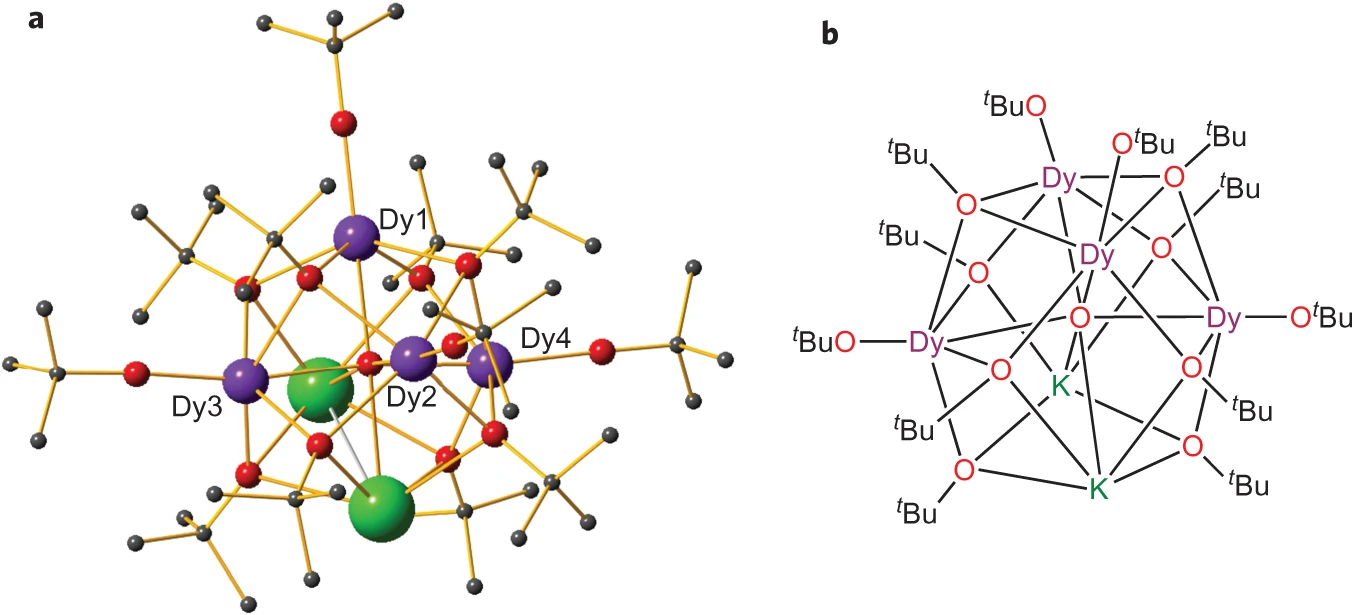
Abstract
Single-molecule magnets are compounds that exhibit magnetic bistability caused by an energy barrier for the reversal of magnetization (relaxation). Lanthanide compounds are proving promising as single-molecule magnets: recent studies show that terbium phthalocyanine complexes possess large energy barriers, and dysprosium and terbium complexes bridged by an N23- radical ligand exhibit magnetic hysteresis up to 13 K. Magnetic relaxation is typically controlled by single-ion factors rather than magnetic exchange (whether one or more 4f ions are present) and proceeds through thermal relaxation of the lowest excited states. Here we report polylanthanide alkoxide cage complexes, and their doped diamagnetic yttrium analogues, in which competing relaxation pathways are observed and relaxation through the first excited state can be quenched. This leads to energy barriers for relaxation of magnetization that exceed 800 K. We investigated the factors at the lanthanide sites that govern this behaviour.
40. Interplay of Strongly Anisotropic Metal Ions in Magnetic Blocking of Complexes
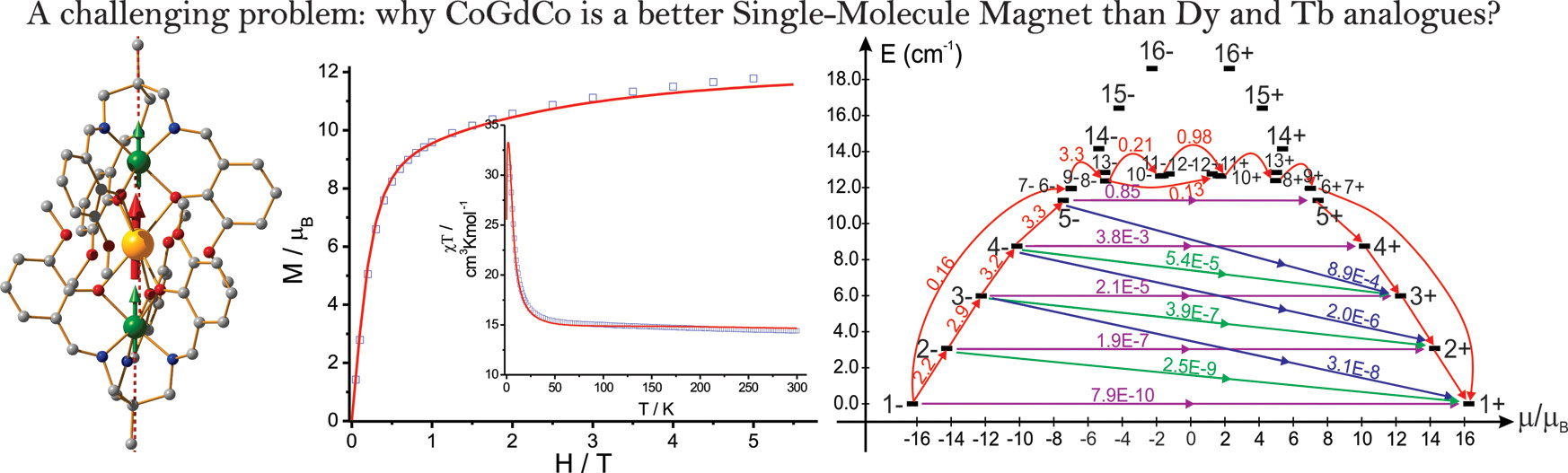
Abstract
The key characteristic of single-molecule magnets (SMMs) is the anisotropy-induced blocking barrier, which should be as efficient as possible, i.e., to be able to provide long magnetic relaxation times at elevated temperatures. The strategy for the design of efficient SMMs on the basis of transition-metal complexes such as Mn12Ac is well established, which is not the case of complexes involving strongly anisotropic metal ions such as cobalt(II) and lanthanides (Ln). While strong intraionic anisotropy in the latter allows them to block the magnetization already in mononuclear complexes, the presence of several such ions in a complex does not result automatically in more efficient SMMs. Here, the magnetic blocking in the series of isostructural 3d–4f complexes CoII–LnIII–CoII, Ln = Gd, Tb, and Dy, is analyzed using an originally developed ab initio based approach for the investigation of blocking barriers. The theoretical analysis allows one to explain the counterintuitive result that the Co–Gd–Co complex is a better SMM than terbium and dysprosium analogues. It turns out that the highly efficient magnetic blockage in the Co–Gd–Co complex results from a concomitant effect of unexpectedly large unquenched orbital momentum on CoII ions (ca. 1.7 μB) and the large spin on the gadolinium (S = 7/2), which provides a multilevel blocking barrier, similar to the one of the classical Mn12Ac. We conclude that efficient SMMs could be obtained in complexes combining strongly anisotropic and isotropic metal ions with large angular momentum rather than in polynuclear compounds involving strongly anisotropic ions only.
39. By Design: A Macrocyclic 3d-4f Single-Molecule Magnet with Quantifiable Zero-Field Slow Relaxation of Magnetization
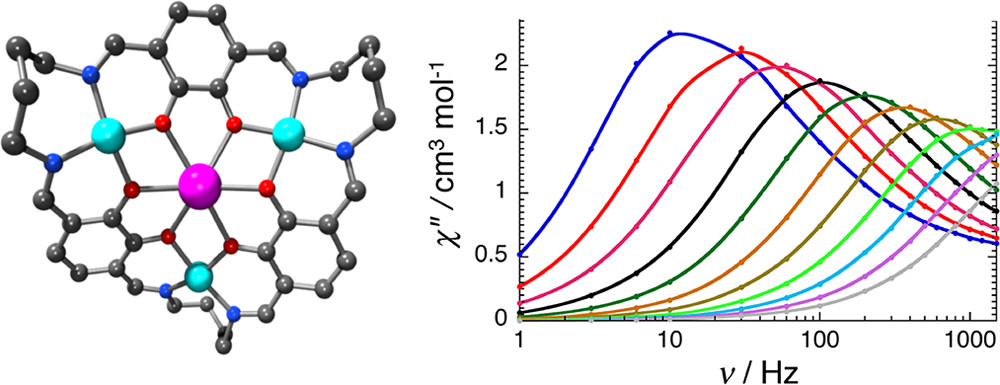
Abstract
Rational modification of the equatorially bound tetranucleating macrocycle in the previously reported SMM complex of the propylene linked macrocycle [CuII3TbIII(LPr)](NO3)2, to a new butylene linked analogue, is shown to tune the ligand field imposed on the encapsulated CuII3TbIII cluster. This results in apical binding of two, rather than one, nitrate ions to the oblate TbIII ion, giving enhanced uniaxial anisotropy and SMM properties despite the low symmetry of the TbIII site. The resulting complex, [CuII3TbIII(LBu)(NO3)2(MeOH)(H2O)](NO3)·3H2O, is the first example of a macrocyclic 3d-4f single-molecule magnet that exhibits quantifiable relaxation of magnetization in zero dc field (Δeff/kB = 19.5(5) K; τ0 = 3.4 × 10⁻⁷ s). This SMM complex of this new, larger, tetranucleating macrocycle was prepared by the template method from the 3:3:3:1 reaction of 1,4-diformyl-2,3-dihydroxybenzene/diaminobutane/copper(II) acetate/terbium(III) nitrate. Similarly, the analogues, Zn3Tb(LBu)(NO3)3·MeOH·H2O·DMF and [Cu3La(LBu)(NO3)2(MeOH)(H2O)2](NO3)·H2O·DMF, were prepared in order to facilitate the detailed magnetic analysis. Both copper(II) complexes were also structurally characterized, confirming the expected binding mode: lanthanide(III) ion in the central O6 pocket, and the three copper(II) ions in the outer N2O2 pockets.
38. An Organometallic Building Block Approach To Produce a Multidecker 4f Single-Molecule Magnet
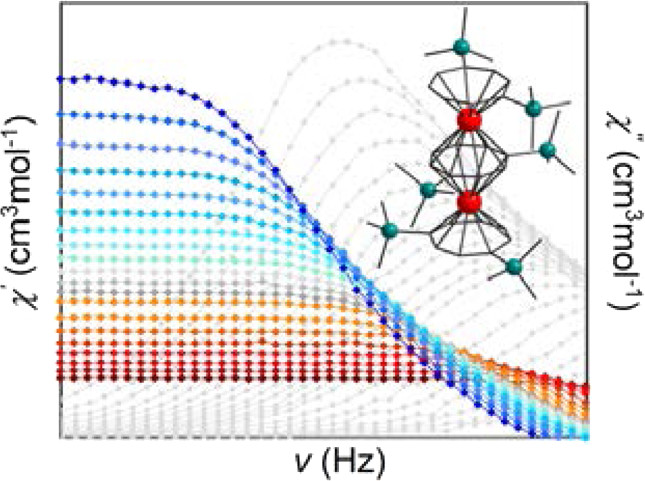
Abstract
An organometallic building block strategy was employed to investigate the magnetic properties of a LnIII organometallic single-ion magnet (SIM) and subsequent single-molecule magnet (SMM) after coupling two of the monomeric units. New homoleptic DyIIICOT″2 and LnIII2COT″3 (Ln = Gd, Dy) complexes have been synthesized. DFT calculations of the bimetallic DyIII complex indicate strong metal–ligand covalency and uneven donation to the DyIII ions by the terminal and internal COT″2- (cyclooctatetraenide) rings that correlate with the respective bond distances. Interestingly, the studies also point to a weak covalent interaction between the metal centers, despite a large separation. The ac susceptibility data indicates that both DyIIICOT″2 and DyIII2COT″3 act as an SIM and an SMM, respectively, with complex multiple relaxation mechanisms. Ab initio calculations reveal the direction of the magnetic anisotropic axis is not perpendicular to the planar COT″ rings for both DyIIICOT″2 and DyIII2COT″3 complexes due to the presence of trimethylsilyl groups on the COT″ rings. If these bulky groups are removed, the calculations predict reorientation of the anisotropic axis can be achieved.
37. Magnetic anisotropy of CoII-WV ferromagnet: single crystal and ab initio study
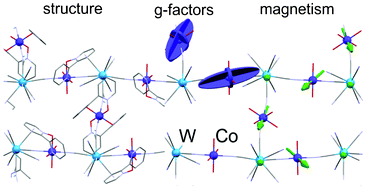
Abstract
The novel layered {CoII3(2,2′-bpdo)4(H2O)4[WV(CN)8]2}·8H2O (1) network (2,2′-bpdo = 2,2′-bipyridine-1,1′-dioxide) is built of 2-D corrugated cyanide-bridged brick-wall skeletons parallel to the bc crystallographic plane. The coordination of chelating 2,2′-bpdo to Co(II) gives 7-membered coordination rings. Magnetic and heat capacity measurements performed on monocrystalline samples reveal ferromagnetic ordering below TC of 6 K. Magnetic anisotropy of the ordered phase is represented by the easy axis oriented in the ac crystallographic plane. Bulk magnetic anisotropy is confronted with a local anisotropy of Co complexes: a strong axial anisotropy of trans,cis,cis-[CoII(μ-NC)2(H2O)2(2,2′-bpdo)] moieties represented by gx(2) = 2.06, gy(2) = 2.95 and gz(2) = 7.30, and a planar anisotropy of trans,cis,cis-[CoII(μ-NC)2(2,2′-bpdo)2] represented by gx(3) = 5.40, gy(3) = 4.82 and gz(3) = 2.28, determined by CASSCF/RASSI/SINGLE_ANISO ab initio calculations. The experimental data are explained by the molecular field simulation of the magnetic structure using the above theoretical data.
36. Relaxations in heterolanthanide dinuclear single-molecule magnets
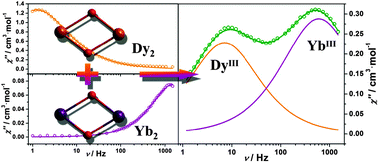
Abstract
A heterospin dinuclear complex [Dy0.87Yb1.13(H2cht)2Cl4(H2O)(MeCN)]·MeCN shows shifts of the relaxation barriers with respect to the barriers observed in homospin Dy2 and Yb2 isostructural complexes. The origin of slow relaxation in the latter two compounds was elucidated by ab initio calculations.
35. Switching the anisotropy barrier of a single-ion magnet by symmetry change from quasi-D5h to quasi-Oh
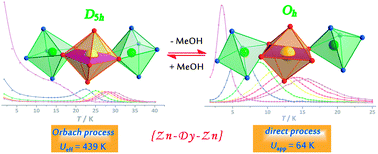
Abstract
A reversible single-crystal-to-single-crystal transformation is used to dramatically change the relaxation behavior of a single-ion magnet. The coordination geometry of the DyIII site of a [Zn–Dy–Zn] complex changes from pentagonal–bipyramid (quasi-D5h) to octahedron (quasi-Oh), inducing an energy barrier change from 305 cm-1 (439 K) to a negligible value, respectively. Ab initio calculations reveal that the ideal D5h–DyIII is of perfect axiality with a substantial energy barrier in accordance with the experimental result.
34. A hydride-ligated dysprosium single-molecule magnet
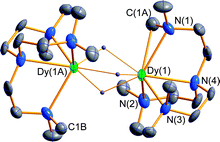
Abstract
An experimental and ab initio computational study of an unsymmetrical, hydride-bridged di-dysprosium single-molecule magnet is reported.
2012
33. Negative g Factors, Berry Phases, and Magnetic Properties of Complexes
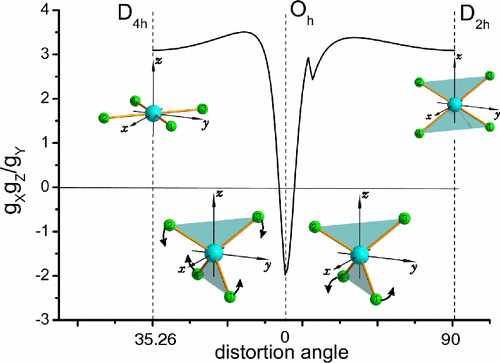
Abstract
It is shown that the sign of the product of three Zeeman splitting factors corresponding to the main magnetic axes defines the sign of the Berry phase of a (pseudo) spin in an applied magnetic field. Ab initio calculations show that gXgYgZ < 0 is often the case for lanthanide and transition metal complexes, while we prove that it is never achieved in S complexes with dominant second-order magnetic anisotropy. In the case of polynuclear compounds, it is argued that the signs of individual gi, i = X, Y, Z, on each metal site can be extracted from experiment.
32. A single-molecule magnet assembly exhibiting a dielectric transition at 470 K
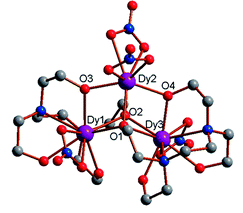
Abstract
A triangular Dy(III) single-molecule magnet (SMM) exhibiting ferroelectric bistability is assembled in an acentric space group Pna21. Hysteresis loops associated with its SMM behavior together with a two-step slow relaxation of the magnetization are observed below 30 K. A transition with dielectric anomalies between a paraelectric and a ferroelectric phase occurs at 470 K.
31. Net Toroidal Magnetic Moment in the Ground State of a {Dy6}-Triethanolamine Ring
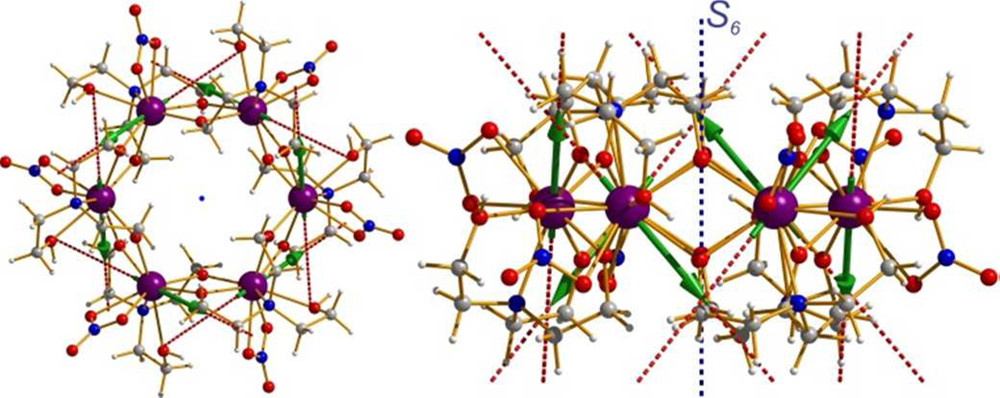
Abstract
A toroidal magnetic moment in the absence of conventional total magnetic moment is observed in a {Dy6} ring. The reason for the net toroidal arrangement of the local magnetic moments is the high symmetry of the complex in combination with strong intra-molecular dipolar interactions between Dy ions. The description of single-ion and inter-ion anisotropic magnetic interactions is achieved here for the first time fully ab initio, i.e., without use of phenomenological parameters.
30. Heterometallic Tetranuclear [LnIII2CoIII2] Complexes Including Suppression of Quantum Tunneling of Magnetization in the [DyIII2CoIII2] Single Molecule Magnet
![Graphical abstract for Heterometallic Tetranuclear [Ln<sup>III</sup><sub>2</sub>Co<sup>III</sup><sub>2</sub>] Complexes Including Suppression of Quantum Tunneling of Magnetization in the [Dy<sup>III</sup><sub>2</sub>Co<sup>III</sup><sub>2</sub>] Single Molecule Magnet](assets/publications/2012/Langley_IC_2012.png)
Abstract
Using a heterometallic approach the synthesis, structures, and magnetic properties are reported for the complexes [LnIII2CoIII2(OMe)2(teaH)2(O2CPh)4(MeOH)4](NO3)2·MeOH·H2O {Ln = Gd (1a), Tb (2a), and Dy (3a)} and [LnIII2CoIII2(OMe)2(teaH)2(O2CPh)4(MeOH)2(NO3)2]·MeOH·H2O {Ln = Gd (1b), Tb (2b), and Dy (3b)}. Both compounds for the respective lanthanide ions are found to be isolated within the same crystal. Each LnIII dinuclear unit is incorporated within a diamagnetic CoIII/organic ligand backbone utilizing triethanolamine and benzoic acid as bridging ligands. Magnetic studies reveal an absence of any observable coupling interaction for the Gd case. The Dy analogue displays single molecule magnet (SMM) behavior with a large energy barrier to magnetization reversal of 88.8 K, and the quantum tunneling of the magnetization (QTM) is effectively suppressed because of the nonmagnetic exchange ground state of the molecule. Dilution of the Dy complex into an isostructural diamagnetic yttrium matrix allowed us to determine aspects of the relaxation mechanism within the system.
29. Synthesis and Magnetic Properties of a New Family of Macrocyclic MII3LnIII Complexes: Insights into the Effect of Subtle Chemical Modification on Single-Molecule Magnet Behavior
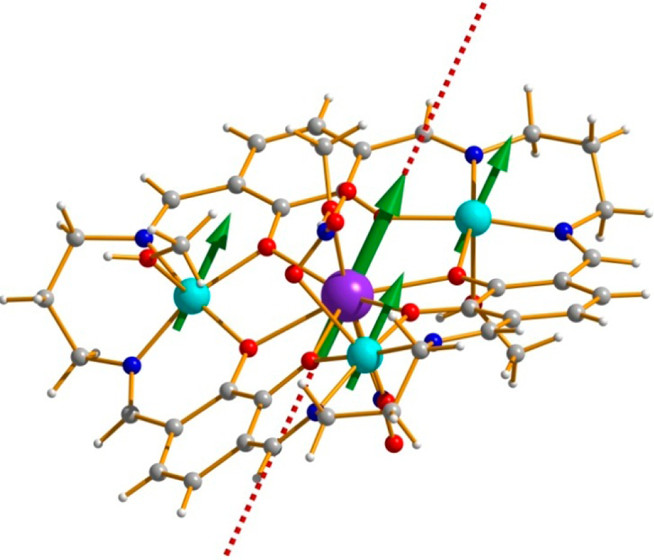
Abstract
Thirteen tetranuclear mixed-metal complexes of the hexaimine macrocycle (LPr)6- have been prepared in a one-pot 3:1:3:3 reaction of copper(II) acetate hydrate, the appropriate lanthanide(III) nitrate hydrate, 1,4-diformyl-2,3-dihydroxybenzene (1), and 1,3-diaminopropane. The resulting family of copper(II)–lanthanide(III) macrocyclic complexes has the general formula CuII3LnIII(LPr)(NO3)3·solvents (Ln = La, Ce, Pr, Nd, Sm, Eu, Gd, Dy, Tb, Ho, Er, Tm, or Yb). X-ray crystal structure determinations carried out on [Cu3Ce(LPr)(NO3)3(MeOH)3] and [Cu3Dy(LPr)(NO3)3(MeOH)3] confirmed that the large LnIII ion is bound in the central O6 site and the three square pyramidal CuII ions in the outer N2O2 sites (apical donor either nitrate anion or methanol molecule) of the Schiff base macrocycle. Only the structurally characterized Cu3Tb complex, reported earlier, is a single-molecule magnet (SMM): the other 12 complexes do not exhibit an out-of-phase ac susceptibility signal or hysteresis of magnetization in a dc field. Ab initio calculations allowed us to rationalize the observed magnetic properties, including the significant impact of subtle chemical modification on SMM behavior. Broken-symmetry density functional theory (BS-DFT) calculations show there is a subtle structural balance as to whether the Cu···Cu exchange coupling is ferro- or antiferromagnetic. Of the family of 13 magnetically characterized tetranuclear CuII3LnIII macrocyclic complexes prepared, only the TbIII complex is an SMM: the theoretical reasons for this are discussed.
28. From a Dy(III) Single Molecule Magnet (SMM) to a Ferromagnetic [Mn(II)Dy(III)Mn(II)] Trinuclear Complex
![Graphical abstract for From a Dy(III) Single Molecule Magnet (SMM) to a Ferromagnetic [Mn(II)Dy(III)Mn(II)] Trinuclear Complex](assets/publications/2012/Bhunia_IC_2012.png)
Abstract
The Schiff base compound 2,2'-{[(2-aminoethyl)imino]bis[2,1-ethanediyl-nitriloethylidyne]}bis-2-hydroxy-benzoic acid (H4L) as a proligand was prepared in situ. This proligand has three potential coordination pockets which make it possible to accommodate from one to three metal ions allowing for the possible formation of mono-, di-, and trinuclear complexes. Reaction of in situ prepared H4L with Dy(NO3)3·5H2O resulted in the formation of a mononuclear complex [Dy(H3L)2](NO3)·(EtOH)·8(H2O) (1), which shows SMM behavior. In contrast, reaction of in situ prepared H4L with Mn(ClO4)2·6H2O and Dy(NO3)3·5H2O in the presence of a base resulted in a trinuclear mixed 3d-4f complex (NHEt3)2[Dy{Mn(L)}2](ClO4)·2(H2O) (2). At low temperatures, compound 2 is a weak ferromagnet. Thus, the SMM behavior of compound 1 can be switched off by incorporating two Mn(II) ions in close proximity either side of the Dy(III). This quenching behavior is ascribed to the presence of the weak ferromagnetic interactions between the Mn(II) and Dy(III) ions, which at T > 2 K act as a fluctuating field causing the reversal of magnetization on the dysprosium ion. Mass spectrometric ion signals related to compounds 1 and 2 were both detected in positive and negative ion modes via electrospray ionization mass spectrometry. Hydrogen/deuterium exchange (HDX) reactions with ND3 were performed in a FT-ICR Penning-trap mass spectrometer.
27. Ab initio calculation of anisotropic magnetic properties of complexes. I. Unique definition of pseudospin Hamiltonians and their derivation
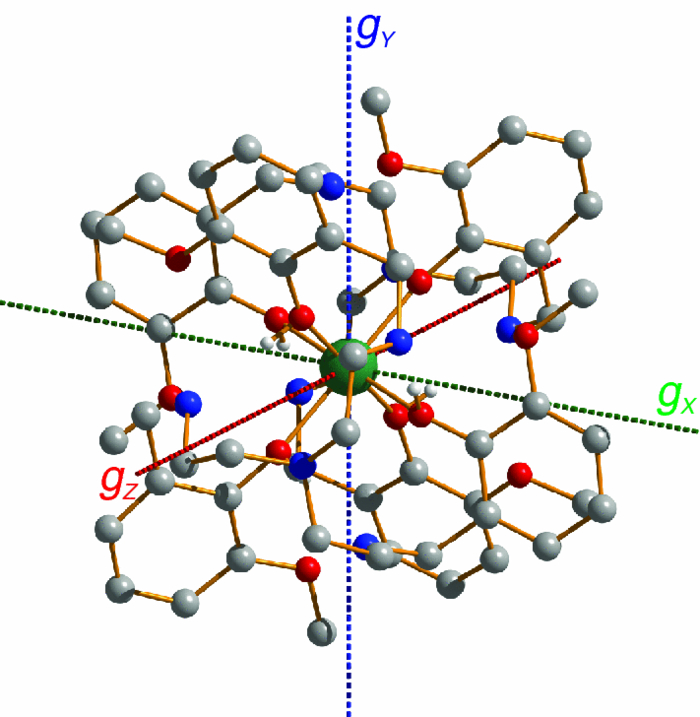
Abstract
A methodology for the rigorous nonperturbative derivation of magnetic pseudospin Hamiltonians of mononuclear complexes and fragments based on ab initio calculations of their electronic structure is described. It is supposed that the spin-orbit coupling and other relativistic effects are already taken fully into account at the stage of quantum chemistry calculations of complexes. The methodology is based on the establishment of the correspondence between the ab initio wave functions of the chosen manifold of multielectronic states and the pseudospin eigenfunctions, which allows to define the pseudospin Hamiltonians in the unique way. Working expressions are derived for the pseudospin Zeeman and zero-field splitting Hamiltonian corresponding to arbitrary pseudospins. The proposed calculation methodology, already implemented in the SINGLE_ANISO module of the MOLCAS-7.6 quantum chemistry package, is applied for a first-principles evaluation of pseudospin Hamiltonians of several complexes exhibiting weak, moderate, and very strong spin-orbit coupling effects.
26. A Six-Coordinate Ytterbium Complex Exhibiting Easy-Plane Anisotropy and Field-Induced Single-Ion Magnet Behavior
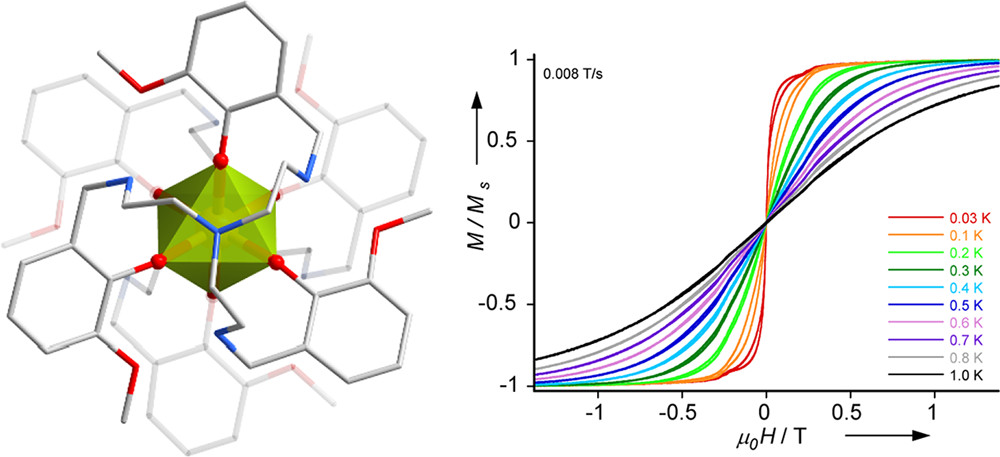
Abstract
The field-induced blockage of magnetization behavior was first observed in an YbIII-based molecule with a trigonally distorted octahedral coordination environment. Ab initio calculations and micro-SQUID measurements were performed to demonstrate the exhibition of easy-plane anisotropy, suggesting the investigated complex is the first pure lanthanide field-induced single-ion magnet (field-induced SIM) of this type. Furthermore, we found the relaxation time obeys a power law instead of an exponential law, indicating that the relaxation process should be involved a direct process rather than an Orbach process.
25. The First {Dy4} Single-Molecule Magnet with a Toroidal Magnetic Moment in the Ground State
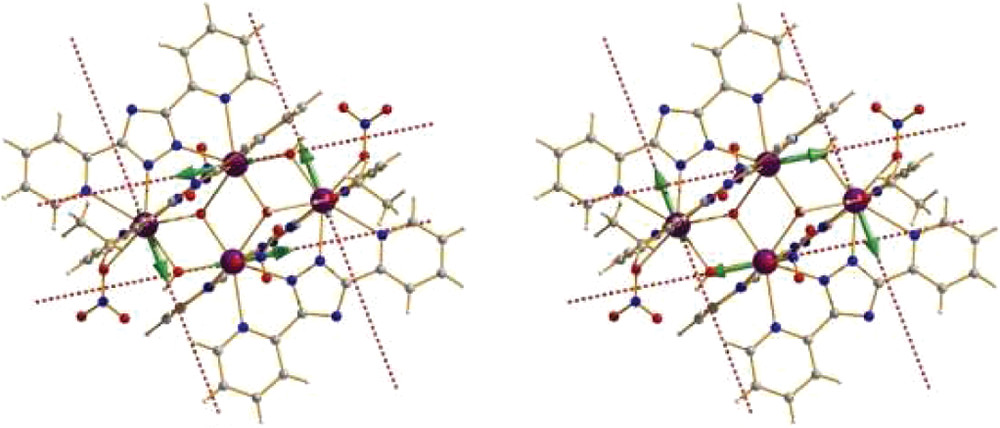
Abstract
A toroidal magnetic moment in the absence of a conventional total magnetic moment was first observed in a novel tetranuclear dysprosium cluster with nonmagnetic ground state. The toroidal state is quite robust with respect to variations of the exchange parameters.
24. Supramolecular architectures for controlling slow magnetic relaxation in field-induced single-molecule magnets
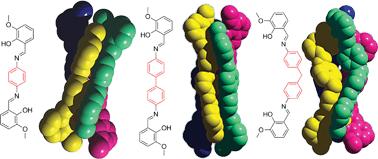
Abstract
In order for molecular magnetic materials to become functional, they must retain their magnetization at reasonable temperatures implying high energy barriers for spin reversal. The field of single-molecule magnets (SMMs) has recently experienced an explosion of research targeting these high anisotropic barriers. Achieving such feats has involved increasing the spin of a complex and/or increasing the inherent magnetic anisotropy. Exerting control over the total spin of a complex has been possible contrary to controlling the global anisotropy. Herein, we report the experimental and theoretical study of local anisotropy alignment on DyIII metal centers and their orientation relative to other centers in rare, dinuclear quadruply-stranded helicate/mesocate complexes. A detailed study of these supramolecular architectures has advanced our knowledge of the origins of magnetic relaxation in SMMs which was shown to arise from minute changes in bond distances around the metal centers leading to changes in the local anisotropy and, in turn, the effective energy barriers.
23. Hysteresis in the ground and excited spin state up to 10 T of a [MnIII6MnIII]3+ triplesalen single-molecule magnet
![Graphical abstract for Hysteresis in the ground and excited spin state up to 10 T of a [Mn<sup>III</sup><sub>6</sub>Mn<sup>III</sup>]<sup>3+</sup> triplesalen single-molecule magnet](assets/publications/2012/Hoeke_CS_2012.png)
Abstract
We have synthesized the triplesalen-based single-molecule magnet (SMM) [MnIII6MnIII]3+ as a variation of our SMM [MnIII6CrIII](BPh4)3. The use of the rod-shaped anion lactate (lac) was intended to enforce a rod packing and resulted in the crystallization of [MnIII6MnIII](lac)3 in the highly symmetric space group R3̄. This entails a crystallographic S6 symmetry of the [MnIII6MnIII]3+ molecules, which in addition are all aligned with the crystallographic c axis. Moreover, the molecular environment of each [MnIII6MnIII]3+ molecule is highly symmetric. Single-crystals of [MnIII6MnIII](lac)3 exhibit a double hysteresis at 0.3 K with a hysteretic opening not only for the spin ground state up to 1.8 T, but also for an excited state becoming the ground state at ≈ 3.4 T with a hysteretic opening up to 10 T. Ab initio calculations including spin-orbit coupling establish a non-magnetic behavior of the central MnIII low-spin (l.s.) ion at low temperatures, demonstrating that predictions from ligand-field theory are corroborated in the case of MnIII l.s. by ab initio calculations. Simulations of the field- and temperature-dependent magnetization data indicate that [MnIII6MnIII]3+ is in the limit of weak exchange (J ≪ D) with antiferromagnetic interactions in the trinuclear MnIII3 triplesalen subunits resulting in intermediate S* = 2 spins. Slight ferromagnetic interactions between the two trinuclear MnIII3 subunits lead to a ground state in zero-field that is approximately described by a total spin quantum number S = 4. This ground state exhibits only a very small anisotropy barrier due to the misalignment of the local zero-field splitting tensors. At higher magnetic fields of ≈ 3.4 T, the spin configuration changes to an all-up orientation of the local MnIII spins, with the main part of the Zeeman energy needed for the spin-flip being required to overcome the local MnIII anisotropy barriers, while only minor contributions of the Zeeman energy are needed to overcome the antiferromagnetic interactions. These combined theoretical analyses provide a clear picture of the double-hysteretic behavior of the [MnIII6MnIII]3+ single-molecule magnet with hysteretic openings up to 10 T.
22. Ytterbium can relax slowly too: a field-induced Yb2 single-molecule magnet
Abstract
An unusual dinuclear Yb2 complex isolated using a mixed ligand strategy leads to field-induced SMM behaviour. Low magnetic axiality and a large tunnelling gap lead to significant quantum tunnelling of the magnetisation, which was reduced under an applied static optimum field of 1600 Oe.
21. Coupling Dy3 Triangles to Maximize the Toroidal Moment
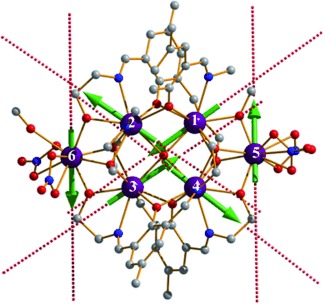
Abstract
A hexanuclear dysprosium(III) compound constructed by two Dy3 triangles in an edge-to-edge arrangement perfectly retains a nonmagnetic ground state and single-molecular-magnet behavior. Such an arrangement and the strong couplings over a μ4-O2- ion stabilize a similar arrangement of toroidal moments in the ground state, thus maximizing the toroidal moment of the complex. (Picture: Dy purple, C gray, N blue, O red.)
20. Coexistence of Distinct Single-Ion and Exchange-Based Mechanisms for Blocking of Magnetization in a CoII2DyIII2 Single-Molecule Magnet
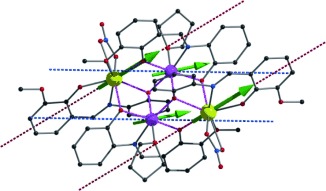
Abstract
Two ways to relax: A defect-dicubane Co2Dy2 single-molecule magnet (SMM) displays slow relaxation of magnetization with a blocking temperature of 22 K (at 1500 Hz), the highest reported for a 3d–4f-based SMM. Analysis of the relaxation reveals two distinct blocking regimes, one of which is intraionic, localized on the DyIII ions, while the other is exchange-based.
19. Heterometallic CuII/DyIII 1D chiral polymers: chirogenesis and exchange coupling of toroidal moments in trinuclear Dy3 single molecule magnets
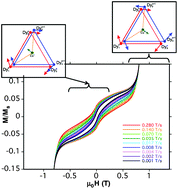
Abstract
The first example of exchange coupling between the toroidal moments in chiral heterometallic CuII/DyIII 1D polymers built from alternating trinuclear Dy3 SMM-building blocks and chiral copper(II) complexes is reported. A very strong toroidal magnetization can be induced by applying a magnetic field at low temperature in single-crystals of these compounds.
18. A High Anisotropy Barrier in a Sulfur-Bridged Organodysprosium Single-Molecule Magnet
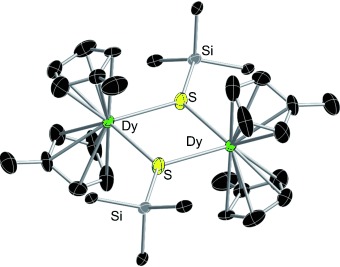
Abstract
The sulfur-bridged dimers [{Cp′2Ln(μ-SSiPh3)}2] (Ln=Gd (1), Dy (2); Cp′=η5-C5H4Me) were synthesized by the transmetalation reactions between [Cp′3Ln] and Ph3SiSLi. Compound 2 is a single-molecule magnet with slow relaxation of magnetization up to 40 K and an anisotropy barrier of Ueff=133 cm-1. Insight into the SMM properties of 2 and closely related SMMs has been obtained using ab initio calculations.
2011
17. Strong Axiality and Ising Exchange Interaction Suppress Zero-Field Tunneling of Magnetization of an Asymmetric Dy2 Single-Molecule Magnet
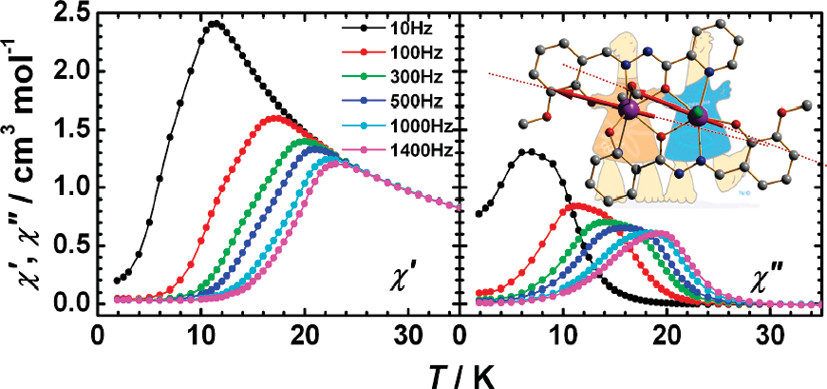
Abstract
The high axiality and Ising exchange interaction efficiently suppress quantum tunneling of magnetization of an asymmetric dinuclear DyIII complex, as revealed by combined experimental and theoretical investigations. Two distinct regimes of blockage of magnetization, one originating from the blockage at individual Dy sites and the other due to the exchange interaction between the sites, are separated for the first time. The latter contribution is found to be crucial, allowing an increase of the relaxation time by 3 orders of magnitude.
16. Structure, Magnetism and Theory of a Family of Nonanuclear CuII5LnIII4 –Triethanolamine Clusters Displaying Single-Molecule Magnet Behaviour
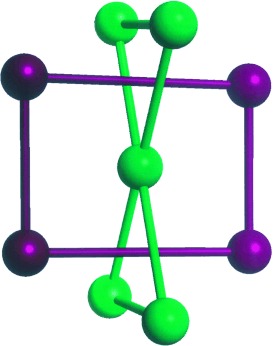
Abstract
Synthesis, crystal structures and magnetic studies are reported for four new heterometallic CuII–LnIII clusters. The reaction of Cu(NO3)2·3H2O with triethanolamine (teaH3), pivalic acid, triethylamine and Ln(NO3)3·6H2O (Ln=Gd, Tb, Dy and Ho) results in the formation of four isostructural nonanuclear complexes of general formula [CuII5LnIII4O2(teaH)4{O2CC(CH3)3}2(NO3)4(OMe)4]·2MeOH·2Et2O [Ln=Gd (1), Tb (2), Dy (3) and Ho (4)]. The metal core of each cluster is made up of four face- and vertex-sharing tetrahedral units. Solid-state DC magnetic susceptibility studies reveal competing anti- and ferromagnetic interactions within each cluster leading to large-spin ground states for 1–4. Solid-state AC magnetic susceptibility studies show frequency-dependent out-of-phase χ''M signals for 2–4 below 4 K, suggestive of single-molecule magnet behaviour. Ab initio calculations on one of the anisotropic examples (3) provided a rare set of J values for Dy–Cu and Cu–Cu exchange interactions (Dy–Dy zero), some ferro- and some antiferromagnetic in character, that explain its magnetic behaviour.
15. Single-Molecule Magnet Behavior for an Antiferromagnetically Superexchange-Coupled Dinuclear Dysprosium(III) Complex
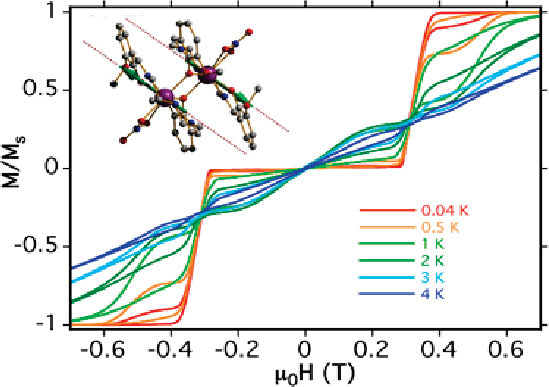
Abstract
A family of five dinuclear lanthanide complexes has been synthesized with general formula [LnIII2(valdien)2(NO3)2] where (H2valdien = N1,N3-bis(3-methoxysalicylidene)diethylenetriamine) and LnIII = EuIII (1), GdIII (2), TbIII (3), DyIII (4), and HoIII (5). The magnetic investigations reveal that 4 exhibits single-molecule magnet (SMM) behavior with an anisotropic barrier Ueff = 76 K. The step-like features in the hysteresis loops observed for 4 reveal an antiferromagnetic exchange coupling between the two dysprosium ions. Ab initio calculations confirm the weak antiferromagnetic interaction with an exchange constant JDy-Dy = -0.21 cm-1. The observed steps in the hysteresis loops correspond to a weakly coupled system similar to exchange-biased SMMs. The Dy2 complex is an ideal candidate for the elucidation of slow relaxation of the magnetization mechanism seen in lanthanide systems.
14. A Non-sandwiched Macrocyclic Monolanthanide Single-Molecule Magnet: The Key Role of Axiality
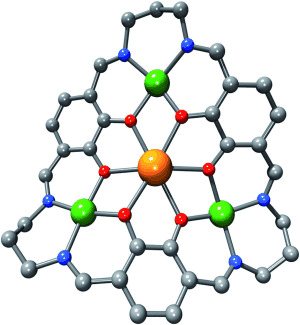
Abstract
Macrocyclic single-molecule magnet: The dynamic behavior of the tetranuclear zinc(II)–dysprosium(III) complex of the hexaimine [3+3] macrocycle (LPr)6- under an external DC field (1500 Oe) indicates that it is a single-molecule magnet (SMM). It is the first to contain a single lanthanide ion (in orange, see graphic) coordinated inside the cavity of a single macrocyclic ligand and thus represents a new class of SMM.
13. A Rare μ4-O Centred Dy4 Tetrahedron with Coordination-Induced Local Chirality and Single-Molecule Magnet Behaviour
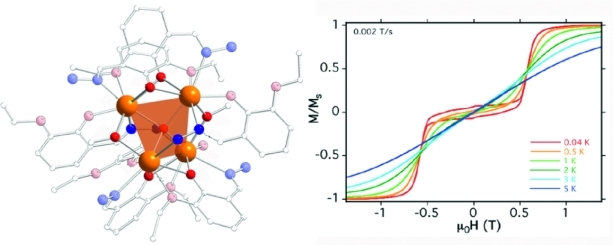
Abstract
Coordination-induced chirality was achieved in a unique tetrahedral [Dy4(μ4-O)(μ-OMe)2(beh)2(esh)4]·3MeOH complex through a twisted diazine bridge from a Schiff base ligand. Magnetic measurements reveal weak intramolecular antiferromagnetic interactions (J = -0.3 cm-1) with single-molecule magnet behaviour (Ueff = 23.42 K).
12. Pure Trinuclear 4f Single-Molecule Magnets: Synthesis, Structures, Magnetism and Ab Initio Investigation
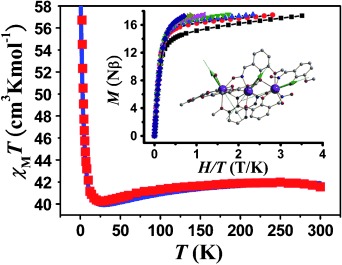
Abstract
A family of linear Dy3 and Tb3 clusters have been facilely synthesized from the reactions of DyCl3, the polydentate 3-methyloxysalicylaldoxime (MeOsaloxH2) ligand with auxiliary monoanionic ligands, such as trichloroacetate, NO3-, OH-, and Cl-. Complexes 1–5 contain a nearly linear Ln3 core, with similar Ln···Ln distances (3.6901(4)–3.7304(3) Å for the Dy3 species, and 3.7273(3)–3.7485(5) Å for the Tb3 species) and Ln···Ln···Ln angles of 157.036(8)–159.026(15)° for the Dy3 species and 157.156(8)–160.926(15)° for the Tb3 species. All three Ln centers are bridged by the two doubly-deprotonated [MeOsalox]2- ligands and two of the four [MeOsaloxH]- ligands through the N,O-η2-oximato groups and the phenoxo oxygen atoms (Dy-O-Dy angles=102.28(16)–106.85(13)°; Tb-O-Tb angles=102.00(11)–106.62(11)°). The remaining two [MeOsaloxH]- ligands each chelate an outer LnIII center through their phenoxo oxygen and oxime nitrogen atoms. Magnetic studies reveal that both Dy3 and Tb3 clusters exhibit significant ferromagnetic interactions and that the Dy3 species behave as single-molecule magnets, expanding upon the recent reports of the pure 4f type SMMs.
11. A Spectroscopic Investigation of Magnetic Exchange Between Highly Anisotropic Spin Centers
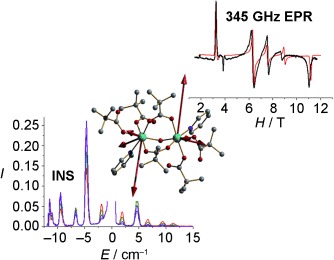
Abstract
Structurally similar, magnetically diverse: The exchange and Zeeman parameters of two dimetallic, six-coordinate CoII compounds—i.e., with orbitally degenerate metal ions—have been determined by a combination of high-resolution EPR and INS spectroscopies, together with ab initio calculations. It is suggested that the correlation between the local crystal field about the CoII centers and the superexchange pathway controls the magnetic interaction.
10. Synthesis, structure, magnetism and theoretical study of a series of complexes with a decanuclear core [LnIII2CuII8] (Ln = Y, Gd, Tb, Dy)
![Graphical abstract for Synthesis, structure, magnetism and theoretical study of a series of complexes with a decanuclear core [Ln<sup>III</sup><sub>2</sub>Cu<sup>II</sup><sub>8</sub>] (Ln = Y, Gd, Tb, Dy)](assets/publications/2011/Borta_NJC_2011.png)
Abstract
A family of four isomorph complexes with a decanuclear [Cu8Ln2] core of general formula [Ln2Cu8(μ-PyO)12(μ4-O)2(μ-Cl)2Cl4(H2O)2]·nH2O [Ln(III) = Y(III) (1), Gd(III) (2), Tb(III) (3), Dy(III) (4); 2-PyOH = 2-hydroxypyridine] was isolated and structurally characterized. All compounds are isomorphs and may be viewed as a hexanuclear central core sandwiched in between two lateral dinuclear copper units. The temperature dependence of the magnetic susceptibility and the field dependence of the magnetization were investigated on polycrystalline samples. The yttrium compound 1 showed an overall behavior dominated by an antiferromagnetic interaction between the copper ions, while for compounds 2–4 the magnetic behavior indicated the addition of a ferromagnetic interaction with the lanthanide ions. The magnetic properties were computationally studied by means of fragment ab initio calculations. The calculation on the yttrium complex allowed determining the strength and sign of the Cu···Cu magnetic interactions considering three antiferromagnetic coupling constants: two within the central (J3 = -44 cm-1) and the lateral (J4 = -40 cm-1) copper dinuclear unit, and one (J5 = -24 cm-1) between the lateral and the central copper. Simulation of the magnetic behavior of the Dy (4) compound gave J1 = +0.25 cm-1 for Dy–Dy and J2 = +2.0 cm-1 for Dy–Cu pairs. The calculated g tensors of the copper(II) ions were found to be quite anisotropic and contributed via anisotropic exchange interactions, together with zero-field (crystal field) splitting on Ln, to the weak single-molecule magnet (SMM) behavior of 2, 3 and 4. Among them, the highest coercivity was found in the gadolinium complex (2), despite the fact that it is much less anisotropic than the other two. We explain this surprising result by a higher multiplicity of the ground spin term in 2 compared to the ground manifolds of states in 3 and 4. Besides, due to relatively large Cu–Gd interaction, the ground exchange term in 2 has enough separation from excited exchange terms, which makes the barrier of reversal of magnetization efficient in this complex.
9. Symmetry related [DyIII6MnIII12] cores with different magnetic anisotropies
![Graphical abstract for Symmetry related [Dy<sup>III</sup><sub>6</sub>Mn<sup>III</sup><sub>12</sub>] cores with different magnetic anisotropies](assets/publications/2011/Liu_CS_2011.png)
Abstract
Two heterometallic [DyIII6MnIII12] clusters comprising of the same [MnIII8O13] fragment, four isolated MnIII ions and two linear [DyIII3] units have been synthesised. Except for the same composition, the main difference of these two cores lies in the coordination environment and the orientations of the linear [DyIII3] units. This difference leads to an alternation in the symmetry of the two cores that significantly modulates their magnetic properties including ground spin state and slow relaxation behavior.
8. Magnetic anisotropy in the excited states of low symmetry lanthanide complexes
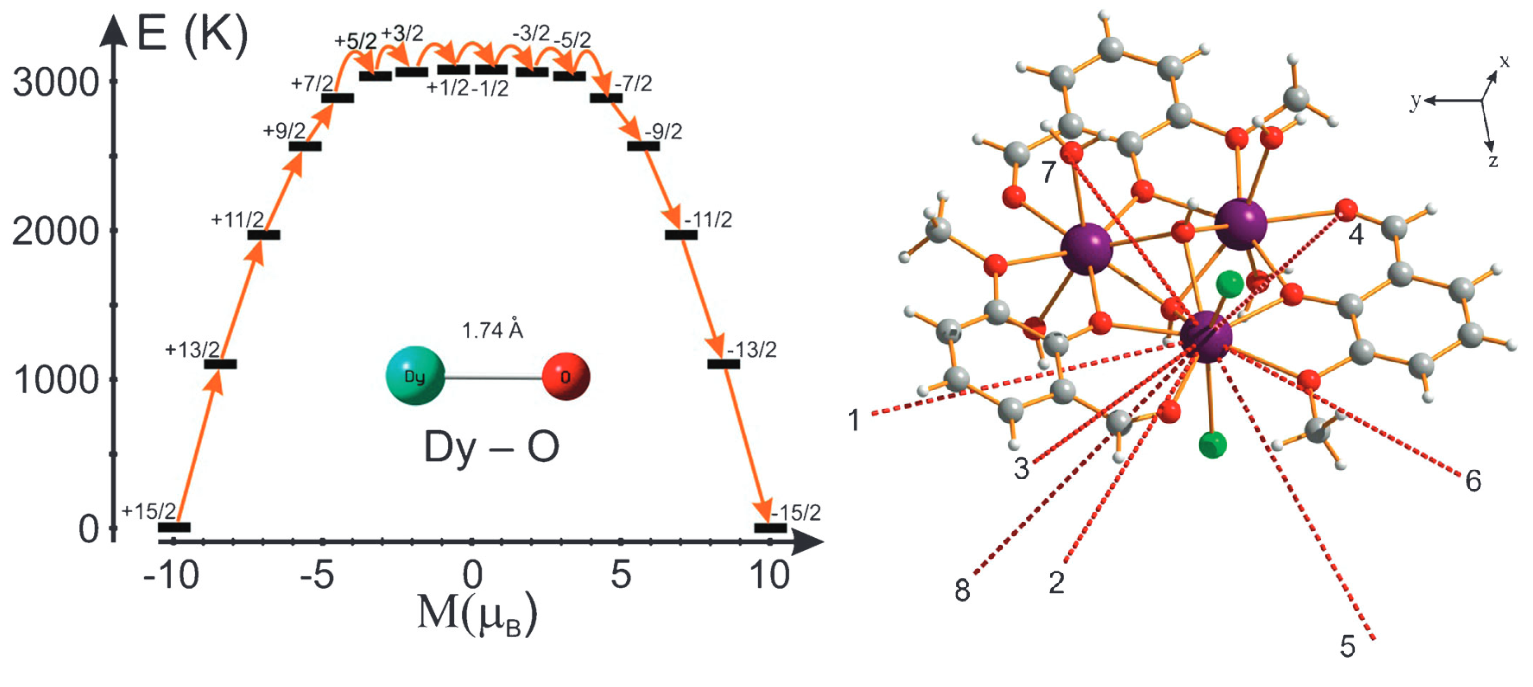
Abstract
Ab initio investigation of multiplet spectrum of lanthanides in archetypal coordination geometries shows an unexpected regular structure consisting of (i) mirror symmetry of anisotropic magnetic properties of doublet states, (ii) high magnetic axiality of low-lying and high-lying doublets, comparable to complexes with ideal axial symmetry, and (iii) the strong rotation of the anisotropy axes of individual doublets. The obtained high axiality of the ground doublet states explains the SMM behaviour of low-symmetry lanthanide complexes.
2010
7. An Octanuclear [CrIII4DyIII4] 3d-4f Single-Molecule Magnet
![Graphical abstract for An Octanuclear [Cr<sup>III</sup><sub>4</sub>Dy<sup>III</sup><sub>4</sub>] 3d-4f Single-Molecule Magnet](assets/publications/2010/Rinck_Angew_2010.png)
Abstract
"Square-within-a-square": The first Cr–Dy single-molecule magnet (SMM) with an energy barrier to spin reorientation of 15 K is presented. The anisotropy in this octanuclear compound arises from the orientations of the four DyIII centers (dark blue), which, in conjunction with the contributions from the CrIII centers (green), leads to the SMM behavior.
2009
6. A Polynuclear Lanthanide Single-Molecule Magnet with a Record Anisotropic Barrier
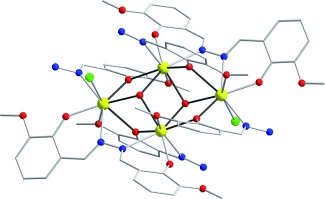
Abstract
Magnetic measurements on a {Dy4} single-molecule magnet (SMM) with a defect-dicubane central core, synthesized using 1,2-bis(2-hydroxy-3-methoxybenzylidene) hydrazone and 3-methoxysalicylaldehyde hydrazone as chelating agents (see structure; yellow Dy, red O, blue N, green Cl), confirm SMM behavior and reveal hysteresis loops at 7 K. The anisotropic energy barrier of Ueff=170 K is the highest reported to date.
5. Ab initio investigation of the non-collinear magnetic structure and the lowest magnetic excitations in dysprosium triangles
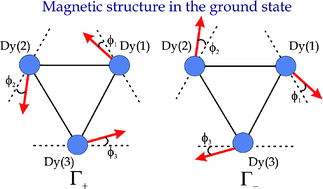
Abstract
The unusual magnetism exhibited by dysprosium triangles [Dy3(μ3-OH)2L3Cl2(H2O)4][Dy3(μ3-OH)2L3Cl(H2O)5]Cl5·19H2O is explained using the recently developed ab initio methodology for the simulation of magnetic properties of complexes. The local anisotropy axes on the dysprosium sites are found to lie in the plane of the Dy3 triangle and to make angles of ca. 120° with each other. The small antiferromagnetic exchange interaction between sites leads to a non-magnetic Kramers doublet in the ground state of the complex. The arrangement of the local magnetization vectors in this state is close to toroidal. By contrast, the lowest excited states are characterized by a huge magnetic moments of ca. 20 μB and show very different behavior of magnetization for fields applied along and perpendicular to the plane of the Dy3 triangle.
4. First Heterotrimetallic {3d-4d-4f} Single Chain Magnet, Constructed from Anisotropic High-Spin Heterometallic Nodes and Paramagnetic Spacers
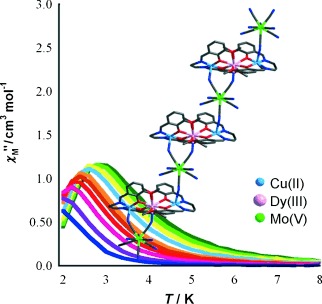
Abstract
Three in one: Heterotrimetallic 1D coordination polymers are designed by assembling heteronuclear nodes (see figure), {Cu2Ln}, with paramagnetic octacyanido-metallates, [M(CN)8]3- (M=Mo, W), acting as spacers. By choosing a strongly anisotropic lanthanide (DyIII), a new single chain magnet is obtained.
2008
3. Structure, Magnetism, and Theoretical Study of a Mixed-Valence CoII3CoIII4 Heptanuclear Wheel: Lack of SMM Behavior despite Negative Magnetic Anisotropy
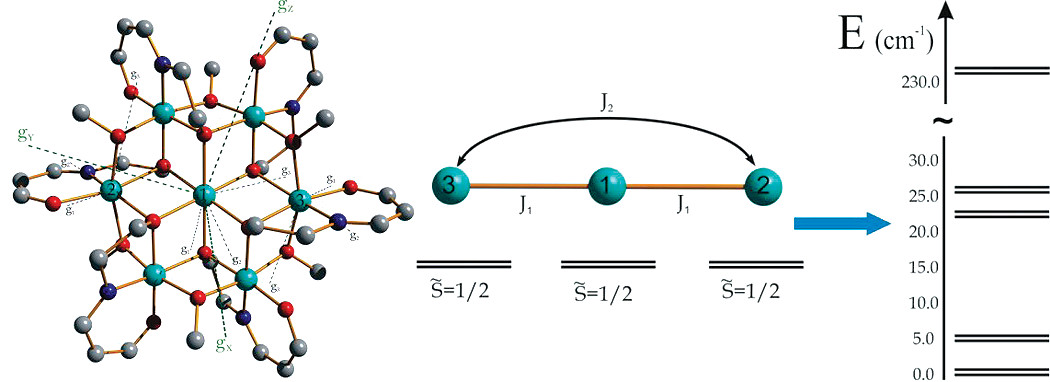
Abstract
A mixed-valence Co(II)/Co(III) heptanuclear wheel [CoII3CoIII4(L)6(MeO)6] (LH2 = 1,1,1-trifluoro-7-hydroxy-4-methyl-5-aza-hept-3-en-2-one) has been synthesized and its crystal structure determined using single-crystal X-ray diffraction. The valence state of each cobalt ion was established by bond valence sum calculations. Studies of the temperature dependence of the magnetic susceptibility and the field dependence of the magnetization evidence ferromagnetic interactions within the compound. In order to understand the magnetic properties of this Co7 wheel, we performed ab initio calculations for each cobalt fragment at the CASSCF/CASPT2 level, including spin-orbit coupling effects within the SO-RASSI approach. The four Co(III) ions were found to be diamagnetic and to give a significant temperature-independent paramagnetic contribution to the susceptibility. The spin-orbit coupling on the three Co(II) sites leads to separations of ~200 cm-1 between the ground and excited Kramers doublets, placing the Co7 wheel into a weak-exchange limit in which the lowest electronic states are adequately described by the anisotropic exchange interaction between the lowest Kramers doublets on Co(II) sites. Simulation of the exchange interaction was done within the Lines model, keeping the fully ab initio treatment of magnetic anisotropy effects on individual cobalt fragments using a recently developed methodology. A good description of the susceptibility and magnetization was obtained for nearest-neighbor (J1) and next-nearest-neighbor (J2) exchange parameters (1.5 and 5.5 cm-1, respectively). The strong ferromagnetic interaction between distant cobalt ions arises as a result of low electron-promotion energies in the exchange bridges containing Co(III) ions. The calculations showed a large value of the magnetization along the main magnetic axis (10.1 µB), which is a combined effect of the ferromagnetic exchange interaction and negative magnetic anisotropy on the two marginal Co(II) sites. The lack of single-molecule magnet behavior in [CoII3CoIII4(L)6(MeO)6] is explained by relatively large matrix elements of transverse magnetic moments between states of maximal magnetization of the ground Kramers doublet, evidenced by ab initio calculations, and the associated large tunneling rates between these states in the presence of dipolar transverse magnetic fields in the crystal.
2. The Origin of Nonmagnetic Kramers Doublets in the Ground State of Dysprosium Triangles: Evidence for a Toroidal Magnetic Moment
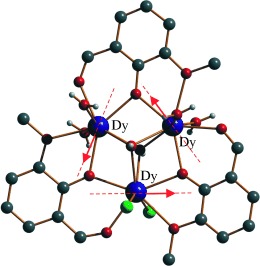
Abstract
Triangular donuts: High-level ab initio calculations reveal a toroidal arrangement of local magnetizations at dysprosium sites in the ground state of triangular dysprosium complexes (see picture), an arrangement that explains their unusual magnetic properties.
2007
1. A dinuclear cobalt(II) complex of calix[8]arenes exhibiting strong magnetic anisotropy
![Graphical abstract for A dinuclear cobalt(II) complex of calix[8]arenes exhibiting strong magnetic anisotropy](assets/publications/2007/Petit_DT_2007.png)
Abstract
The solvothermal reaction of cobalt(II) acetate with p-tert-butylcalix[8]arene (calix) and triethylamine affords the compound (Et3NH)2[CoII2(calix)2] (1·2Et3NH) that shows a hydrogen bond bridged dinuclear complex [CoII2(calix)2]2- (1) with cobalt(II) ions in a tetrahedral geometry. The compound crystallises in the monoclinic, space group P21/n with cell parameters a = 14.89(1) Å, b = 20.90(2) Å, c = 30.87(4) Å, β = 102.57(7)°, V = 9376(16) Å3, Z = 2. The magnetic studies together with ab initio calculations are evidence of an important role of the geometry of the second coordination sphere of carbon and hydrogen atoms around the CoO4 core in quantifying the zero-field splitting on cobalt sites. This results in strong magnetic anisotropies with a negative axial component on the cobalt fragments.